QubicX vs Ollama — Complete On-Premise AI Deployment Comparison
Both QubicX and Ollama enable on-premise deployment of large language models, but they are positioned very differently. QubicX is a complete enterprise-grade on-premise AI solution offering fully integrated hardware and software with professional technical support; Ollama is an open-source tool for running LLMs locally, suited to individual developer experimentation and rapid prototyping. This article provides a comprehensive comparison from an enterprise perspective.
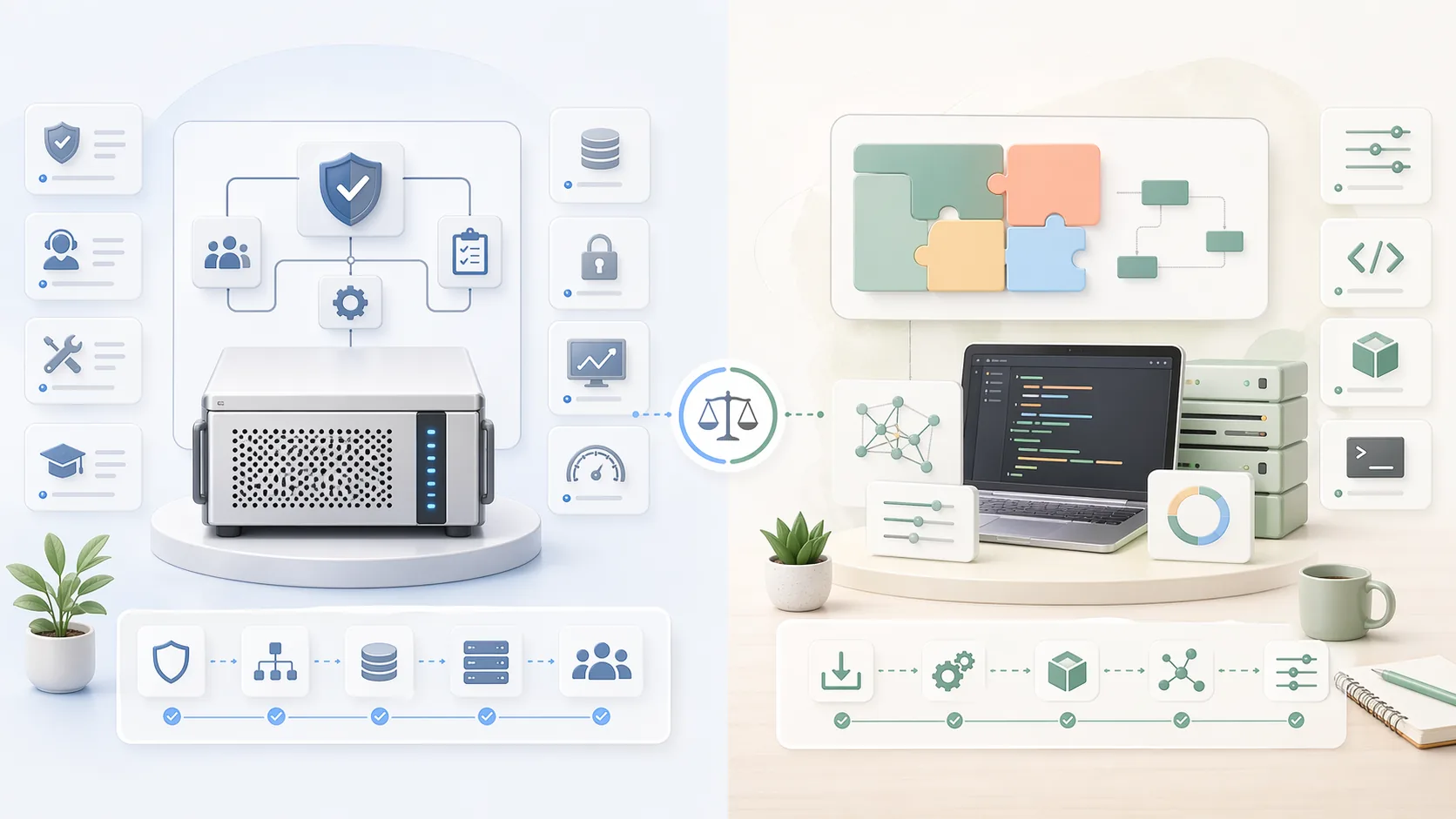
Feature Comparison Table
| Feature | QubicX | Ollama |
|---|---|---|
| Product Positioning | Enterprise-Grade On-Premise AI All-in-One Solution | Open-source local LLM runtime tool suitable for developers and experimental use |
| Hardware Integration | Pre-optimized GPU server hardware configuration, ready to use out of the box | Software-only tool; hardware must be sourced and configured independently |
| Model Management | Enterprise model management, version control, multi-model concurrent execution; actual concurrency limits depend on hardware configurations | Simple model download and execution supporting a wide range of open-source models |
| User Interface | Enterprise-grade web management interface, user access control, and monitoring dashboard | Primarily command-line interface; requires third-party UI (e.g., Open WebUI) for a graphical experience |
| Knowledge Base Integration | Built-in enterprise knowledge base and RAG functionality supporting document upload and semantic search | Basic LLM inference; knowledge base integration requires custom development or additional tools |
| Security and Compliance | Enterprise-grade security architecture, access control, audit logs, and compliance reporting | Designed around running locally on a single machine; enterprise-grade security management features such as user permissions and audit logs are not built in and are outside the project's scope — you need to add them yourself (refer to the official documentation and version for current details) |
| Technical Support | Taiwan-based professional local team providing full installation, operations, and training services | Primarily community-driven open-source support (GitHub Issues, official documentation); refer to its official website for the latest information on whether a commercial support plan is also available |
| Scalability | Supports multi-node cluster deployment, load balancing, and high-availability architecture | Primarily designed for single-node operation; clustering requires self-managed architecture |
| Chinese Language Optimization | Pre-loaded with models tuned for Traditional Chinese, with prompt and retrieval settings that can be adjusted to your industry context | Supports Chinese model downloads, but optimization quality depends on the model itself |
| Cost Structure | All-in-one solution including hardware, software, and services — an enterprise-grade investment | Free and open-source software; only hardware costs required |
This comparison was compiled from each vendor's official public documentation, open-source project repositories, and product descriptions, as of July 2026. Open-source projects update their features frequently, and details may change with each version; please refer to each project's official documentation and latest announcements for current information. If you notice anything that no longer matches reality, please let us know so we can correct it.
In-Depth Feature Analysis
1. Enterprise Readiness
QubicX was built from the ground up as an enterprise on-premise AI solution. It includes a full suite of enterprise-grade capabilities: multi-user access control, operation audit logs, data encryption, an API gateway, health monitoring, and automated alerting. IT departments can centrally manage all AI services through a web-based management console without requiring deep AI technical expertise.
Ollama is an outstanding developer tool enabling anyone to run large language models locally with ease. As shown in its official documentation, project design focuses on model acquisition and execution; enterprise governance features such as user management, access control, and audit tracking are not included in scope (verify with official docs and releases). Deploying at scale across an organization generally demands supplemental engineering effort to build authentication, permission controls, audit logs, monitoring, and alerts.
2. Hardware & Performance Optimization
QubicX provides pre-configured GPU server solutions with hardware specifications optimized for AI inference workloads, covering GPU memory allocation, thermal management, and power delivery. The software stack is also tuned for specific hardware configurations to ensure models run at peak performance. Enterprises do not need to research GPU selection or performance tuning themselves, dramatically shortening the deployment timeline.
As a pure software tool, Ollama offers exceptional ease of use — a single command downloads and runs a model. However, hardware selection, configuration, and performance optimization are entirely the user's responsibility. For enterprise teams without deep GPU computing expertise, the journey from hardware procurement to performance tuning can be highly challenging.
3. Knowledge Base & RAG Integration
QubicX includes a built-in enterprise knowledge base and RAG (Retrieval-Augmented Generation) engine. Enterprises can upload documents directly to build a proprietary knowledge base, enabling the AI assistant to ground its answers in actual company data. This capability is extremely valuable for internal knowledge management, customer service automation, and technical documentation queries — with no need to integrate third-party tools.
Ollama focuses solely on LLM inference and does not include knowledge base or RAG functionality. Enterprises that require RAG capabilities must build their own solution by combining frameworks such as LangChain or LlamaIndex with a vector database such as Chroma or Milvus. This demands a technically capable AI engineering team, and the costs of integration and ongoing maintenance are not trivial.
4. Model Ecosystem & Flexibility
Ollama has a clear advantage in model ecosystem flexibility. It supports rapid download and execution of dozens of open-source models including Llama, Mistral, Gemma, and Phi, and keeps pace with the ecosystem — new models become available through Ollama shortly after release. For teams that need to experiment with different models, prototype quickly, or conduct research, Ollama's flexibility is a significant asset.
QubicX's model list has been tested and tuned against enterprise scenarios, with pre-loaded models optimized for Traditional Chinese and common enterprise applications. Compared with the sheer number of models in open-source tools, we deliberately keep our list to a maintainable size — every model on the list is first confirmed for response quality and resource usage through a standard testing process before it's made available to enterprises. Actual performance still varies with document content and use case, so we recommend validating with your own data during the PoC stage. Enterprises can also request specific models to be loaded as needed, subject to a feasibility assessment by our technical team.
5. Operations & Long-Term Support
QubicX provides comprehensive operational services, including system installation and deployment, regular health checks, software updates and upgrades, performance tuning, and troubleshooting. A local Taiwan technical support team can respond quickly to enterprise needs and deliver training to equip corporate IT teams with the skills needed for day-to-day operations. This is especially valuable for organizations that lack AI infrastructure experience.
Ollama's support comes from the open-source community, including GitHub Issues, a Discord community, and online documentation. The community is highly active and common issues can usually be resolved. However, the open-source community cannot provide guarantees for enterprise-grade troubleshooting, customization requests, or service level agreements (SLAs) — enterprises must assume full operational responsibility themselves.
Key Differentiators
- Product Type: QubicX is a complete enterprise-grade solution with hardware and software included; Ollama is a free, open-source developer tool
- Enterprise Features: QubicX includes built-in access control, audit logs, and knowledge base — enterprise features that Ollama requires you to build yourself
- Technical Support: QubicX is backed by a professional local support team in Taiwan; Ollama relies on the open-source community
- Deployment Complexity: QubicX is ready out of the box with vendor-assisted deployment; Ollama is simple to start but requires significant engineering effort to productionize for enterprise use
- Model Flexibility: Ollama supports a wider range of open-source models with rapid updates; QubicX offers a curated selection of validated, stable models
How do I choose the right plan?
The right choice depends on your use case and organizational capabilities:
- Choose QubicX: If you are an enterprise needing production on-premise AI, value security compliance, require knowledge base integration, lack internal AI infrastructure ops experience, or need technical support with clear accountability. QubicX combines hardware, software, and services under a single window, eliminating DIY integration overhead; actual launch timelines depend on data readiness and security review progress.
- Choose Ollama: If you are a developer or research team that needs to rapidly experiment with different models, build AI prototypes, or explore on-premise AI possibilities on a limited budget. Ollama's free, open-source nature and ease of use make the barrier to entry extremely low.
- Phased Adoption: A common and viable adoption path is starting with Ollama for proof-of-concept (PoC) testing to validate the feasibility and value of on-premise AI in your environment, followed by deploying QubicX for enterprise-grade production. This staged approach builds decision criteria at lower upfront cost before committing to larger investments.
FAQ
Experience QubicX — Enterprise On-Premise AI
From hardware to software to services, a one-stop solution for all your enterprise on-premise AI deployment needs.
Contact Us Learn About QubicX