RAGi vs. LangChain / LlamaIndex: Enterprise RAG Platform vs. Open-Source Framework Complete Comparison
LangChain and LlamaIndex are currently the most popular open-source RAG frameworks among developers, offering tremendous flexibility for engineers to freely combine AI components. RAGi, by contrast, is a complete RAG platform designed for enterprise scenarios, packaging architectural decisions, operational burden, and integration work into a single product. This article objectively compares the two paths to help technical decision-makers choose the option best suited to their needs.
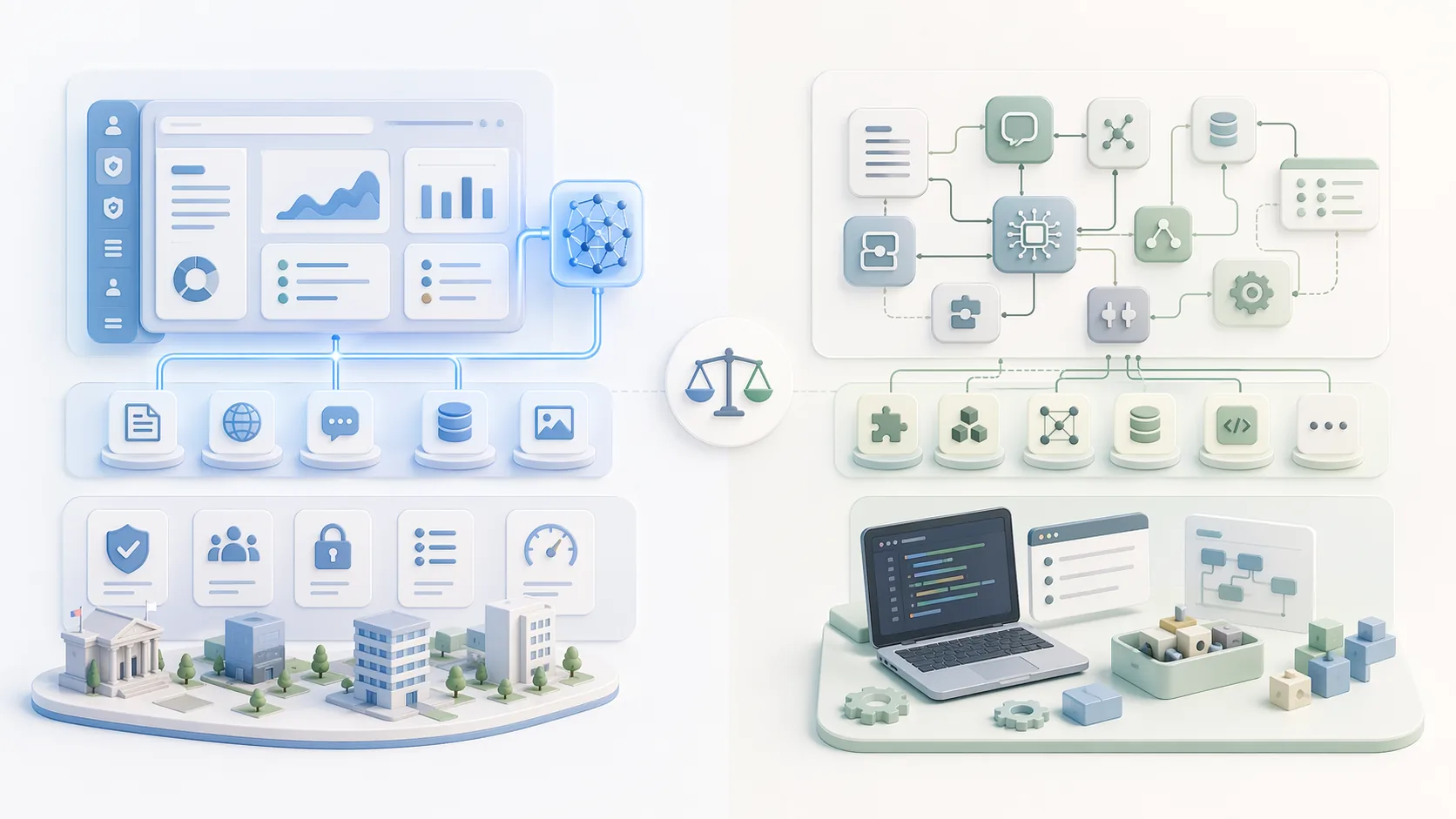
Feature Comparison Table
| Assessment Dimensions | RAGi | LangChain / LlamaIndex |
|---|---|---|
| Product Positioning | Enterprise-grade RAG platform, ready to use out of the box, with a management interface and operational tools | Open-source AI framework providing components and abstraction layers that must be assembled by the user |
| Development complexity | Low: the platform already packages the main architectural decisions, so the technical barrier is low; the actual go-live timeline depends on the knowledge base size and integration scope | High: requires designing the RAG pipeline from scratch, choosing a vector store, and debugging prompts |
| Knowledge Base Integration | Built-in document upload, parsing, chunking, and vectorization pipeline, with Traditional Chinese support | Provides Document Loader, Splitter, and Embedder components that must be wired together by the user |
| Observability | Built-in dashboards for query logs, answer traceability, usage statistics, and anomaly alerts | Can be paired with LangSmith, Phoenix, or a self-built monitoring setup; the framework itself focuses on component assembly, so observability must be introduced separately |
| User Management | Enterprise role permissions, departmental hierarchies, document access control, and audit logs | The framework itself does not include user management; an authentication and authorization layer must be implemented separately |
| Maintenance cost | The vendor handles version upgrades and infrastructure maintenance, keeping the burden on enterprise IT low | Frequent version iterations and many dependencies require dedicated working hours for ongoing tracking and upgrades |
| Deployment Flexibility | Supports on-premise, private cloud, and hybrid cloud deployment, with architecture documentation and a control-measures checklist available to support security reviews | Can be deployed in any environment, but infrastructure selection and operations are entirely the user's own responsibility |
| Enterprise support | Local Taiwan technical team providing adoption, training, and SLA-backed services per contract | LangChain offers a commercial plan (LangSmith), with community support as the primary channel |
| Customization scope | Provides API extension points, but the underlying architecture is not open to modification | Fully open source; any component can be modified, offering tremendous flexibility |
| Time to market (TTM) | Shorter: the platform's functionality is already in place, so the main work is organizing and uploading the knowledge base and completing configuration; actual timing depends on how ready the data is | Longer: building a stable production environment from the framework up requires a considerable amount of engineering time; the actual duration depends on the team's experience and the complexity of the requirements |
| Licensing cost | Commercial licensing with custom quotes based on deployment scale and feature requirements | The framework itself is free and open source, but engineering labor and infrastructure costs can be substantial |
This comparison is compiled from each vendor's official public documentation, open-source project repositories, and product descriptions, as of July 2026. Features and APIs of open-source frameworks are updated frequently and may change with newer versions; please refer to each project's official documentation and latest announcements for current details. If you notice any description that no longer matches reality, please let us know and we will correct it.
The positioning and strengths of LangChain/LlamaIndex
LangChain and LlamaIndex are indispensable tools in an AI engineer's toolbox, both offering rich abstraction layers and components that let developers quickly assemble RAG application prototypes. LangChain emphasizes the flexibility of combining chains (sequential calls) and agents (autonomous decision-making), making it well suited to building complex multi-step AI workflows; LlamaIndex has deep roots in data indexing and query engines, with particular strengths in handling unstructured documents.
For a capable engineering team, these two frameworks offer a flexibility that other options struggle to match. You can freely choose any vector database (Chroma, Milvus, Pinecone, Weaviate...), any LLM (OpenAI, Anthropic, Google Gemini, Mistral...), and any document-format parser, and design a RAG strategy tailored to your business logic. The open-source community is active, documentation is rich, and there is a wealth of sample code on GitHub, so the learning curve is relatively gentle.
This framework-based approach is best suited to the following scenarios: products that need highly customized RAG logic, tech companies whose core competitive advantage is AI capability, R&D teams with sufficient AI engineering resources, and situations that require deeply embedding AI into existing systems. If your team can bear the full cost of design, development, and long-term maintenance, LangChain/LlamaIndex is a powerful choice.
RAGi's differentiated advantage as an enterprise platform
RAGi's starting point is not "a toolbox for developers" but "a RAG system enterprises can use directly." The platform has already packaged the core RAG decisions: the document chunking strategy, embedding model selection, vector retrieval algorithm, and LLM integration interface. Steps that require an engineer to research and implement under the framework approach become configurable parameters in RAGi.
For enterprise IT departments and business units, RAGi's greatest value lies in "de-technicalizing" AI capability: an engineer is not required just to maintain the knowledge base. Business staff can directly upload documents, manage the scope of the knowledge base, and view usage statistics through a web interface. Newly added documents are typically retrievable by the AI as soon as indexing completes, with no code changes required along the way; actual indexing time depends on the volume and format of the documents.
In addition, RAGi has been deeply tuned for Traditional Chinese. Everything from parsing and word/segment splitting of Chinese PDF documents to Chinese semantic vectorization has been validated against real documents from Taiwanese enterprises. A similar result can be achieved via the framework route, but those adjustments require engineers to research and iterate through trial and error on their own; RAGi's approach is to tune the defaults to a usable baseline in advance, so enterprises only need to fine-tune based on their own documents.
Technical capability and feature comparison
RAG pipeline completeness
LangChain and LlamaIndex provide all the components needed to build a RAG pipeline: document loaders, text splitters, embedding model interfaces, vector store abstraction layers, query engines, and answer generation chains. Developers have full control and can inject custom logic at every node. Advanced RAG techniques such as hybrid search, re-ranking, HyDE (Hypothetical Document Embeddings), and self-query all have corresponding sample implementations.
What RAGi provides is a proven RAG pipeline, not a collection of components. Enterprises don't need to research which chunking strategy best suits Chinese documents, compare the performance trade-offs of vector databases, or debug prompt templates: RAGi's engineering team has already completed that work during product development. What enterprises get is a system ready to use immediately, not a set of parts that need to be assembled.
AI agent and workflow capability
LangChain has deep experience in the agent space, offering multiple agent patterns such as ReAct, tool calling, and plan-and-execute, along with a rich set of tool integrations (search engines, calculators, API calls, and more). LangGraph further provides stateful, multi-step agent workflows, making it well suited to building complex AI automation applications.
RAGi likewise supports AI agent functionality, allowing an AI assistant to proactively plan multi-step tasks, call internal enterprise system APIs, and integrate external data sources for compound queries. RAGi's agent capabilities focus on the needs most common in enterprise scenarios: cross-knowledge-base Q&A, multi-turn conversation memory, structured report generation, and workflow triggering, all presented to enterprise users through a configurable interface.
Comparing deployment complexity and maintenance cost
The real cost of choosing LangChain or LlamaIndex often far exceeds the framework's zero licensing fee. Engineers need to do a large amount of architectural design work up front: selecting and deploying a vector database, designing the document processing pipeline, implementing user authentication and permission systems, building monitoring and logging infrastructure, writing tests to ensure RAG quality, and designing a CI/CD pipeline. How long this process takes varies greatly depending on the team's past experience, the complexity of the requirements, and the security review process; it's best estimated against your own team's real schedule rather than applying a single generic number.
More importantly, there's the maintenance cost after go-live. LangChain iterates its versions frequently, and its API occasionally introduces breaking changes; the vector database, embedding model, and LLM services it depends on each have their own update cadence. Maintaining a production framework-based RAG application requires allocating dedicated engineering resources on an ongoing basis over the long term. For enterprises whose core business isn't AI engineering, this is a labor burden that needs to be assessed in advance.
RAGi shifts this maintenance work onto the vendor. Platform version upgrades, security patches, and performance optimization are handled by the LargitData technical team, so enterprise IT only needs to manage and update the knowledge base content. From a TCO (total cost of ownership) perspective, RAGi comes with licensing fees, but relatively saves the engineering labor of building and maintaining the system yourself; there's no standard answer to which side is more economical. It's best to lay out the projected labor cost, project duration in months, and long-term maintenance hours, and compare that against the licensing and service fees.
Comparing security and enterprise-grade requirements
Data security is a core consideration in enterprise RAG deployment. As a framework, LangChain/LlamaIndex does not itself handle data security: how data is encrypted, who can access which knowledge bases, and how API calls are authenticated are entirely up to the implementer. The framework provides interfaces for integrating various security components, but building the security architecture is the engineer's responsibility.
RAGi has an enterprise-grade security architecture built in. Fine-grained document access control (RBAC) ensures that different departments can only query the knowledge bases within their permission scope; a complete operation audit log records query activity and can support audit work for financial institutions and government agencies; on-premise deployment is supported, so sensitive data never leaves the enterprise's internal network. These security features come standard with the product rather than requiring additional development.
For regulated industries such as finance, healthcare, and government agencies, RAGi's on-premise deployment option is an important evaluation criterion. Data is uploaded, processed, and stored entirely within the enterprise's internal network, with access control, audit logs, and encryption provided as control measures that can support your organization's review work around personal data protection, financial industry security regulations, and government security responsibility levels. Whether these actually satisfy the applicable regulations still needs to be confirmed item by item by legal and security staff based on the data type and deployment environment; we can provide architecture documentation and the materials needed for an audit.
How to choose: a decision guide for framework vs. platform
This choice is fundamentally the classic IT decision of "build vs. buy." There's no universally correct answer; it depends on the characteristics of your organization.
- Situations where LangChain/LlamaIndex is the right choiceYou already have AI engineering resources you can commit to long-term, your RAG logic is so highly customized that no platform can satisfy it, AI capability is a core product differentiator, you need deep integration with existing systems, or you're pursuing maximum technical flexibility. Both frameworks are quite widely adopted in the developer community, with rich documentation and examples, making them a reasonable choice for teams capable of maintaining them on their own.
- When to Choose RAGiYour core business isn't AI engineering, you want to shorten the time from evaluation to go-live, security review and on-premise deployment matter to you, you want business staff to be able to manage the knowledge base directly, or you want the vendor to shoulder long-term maintenance responsibility. For organizations without dedicated in-house AI engineering staff, the platform route can usually skip a great deal of architecture selection and trial-and-error work.
- Hybrid strategySome enterprises adopt RAGi as the standard platform for enterprise knowledge base Q&A, while letting the AI engineering team use LangChain to develop highly customized applications for specific scenarios (such as automated financial report analysis or regulatory document comparison). The two approaches are not mutually exclusive.