ASR Automatic Speech Recognition Explained: The AI Revolution from Voice to Text
ASR (Automatic Speech Recognition) is an AI technology that enables computers to "listen" to human speech and convert it into text. From smartphone voice assistants to real-time meeting captions and call center analytics, ASR has become deeply embedded in modern life. As deep learning and large language models advance, speech recognition accuracy and applicability are expanding rapidly. This article provides a comprehensive breakdown of ASR's technical principles, development history, core challenges, and enterprise applications.
The Technical Principles and Core Architecture of ASR
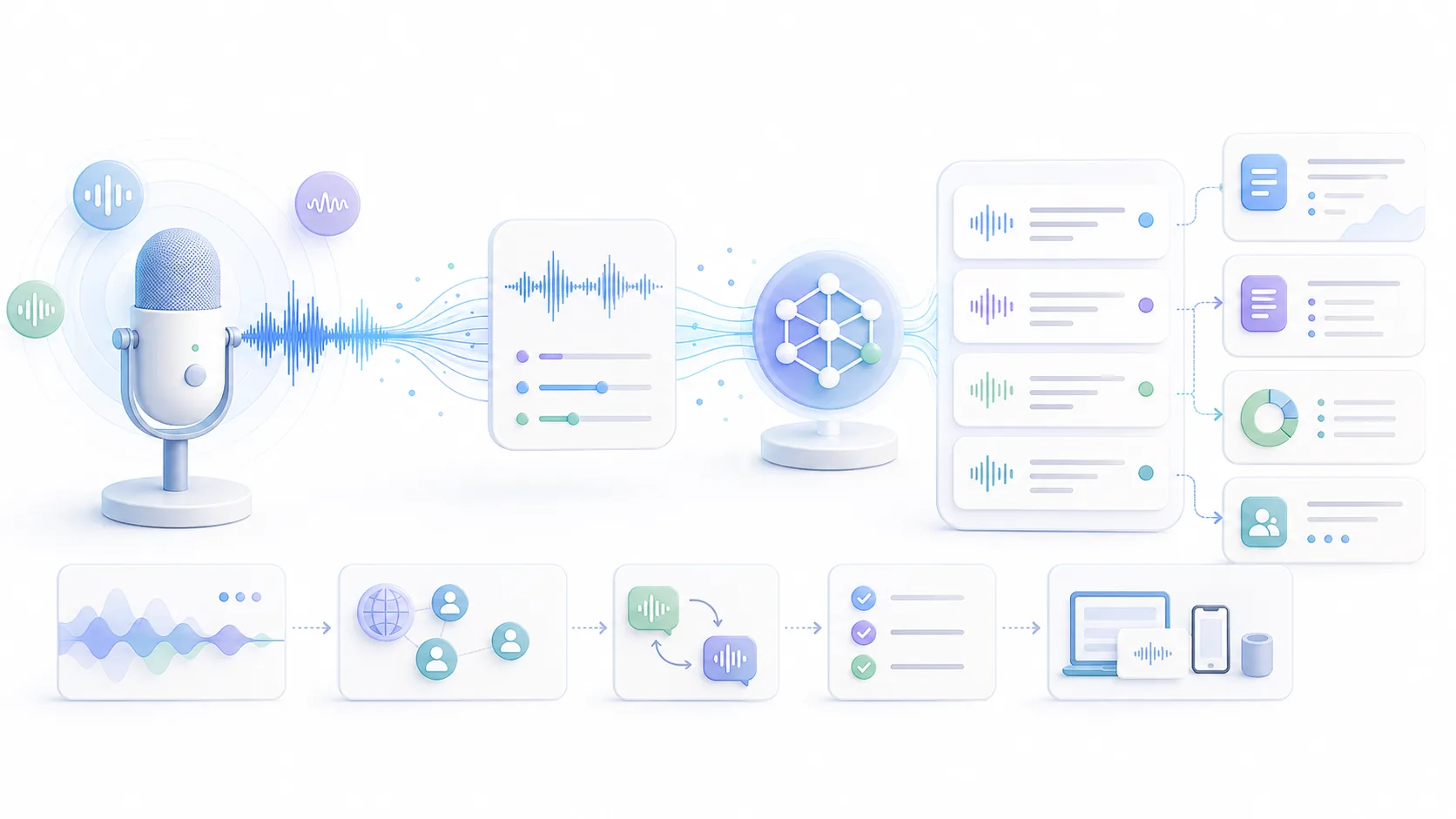
At its core, speech recognition converts a continuous audio signal into a corresponding sequence of text. While this process feels natural to humans — who begin learning it from infancy — it is an extremely complex task for computers. A speech signal is a continuous waveform that encodes multiple layers of information: linguistic content, speaker characteristics, and ambient noise. An ASR system must accurately extract the linguistic content from this rich signal.
Traditional ASR systems use a pipeline architecture composed of multiple independent modules: acoustic feature extraction (e.g., MFCC, Fbank) converts raw audio into feature vector sequences; the Acoustic Model maps acoustic features to phoneme sequences; the Language Model ranks candidate text sequences based on statistical language patterns; and the Decoder combines acoustic and language model outputs to produce the final recognition result.
Modern ASR systems have transitioned to end-to-end deep learning architectures, unifying multiple legacy modules into a single neural network. Mainstream end-to-end architectures include CTC (Connectionist Temporal Classification) models, attention-based models (such as Listen-Attend-Spell), and Transformer-based models. Conformer (combining Convolutional Neural Networks with Transformers) is a prevalent modern architecture balancing local acoustic features with long-range context; however, architectural efficacy is inextricably linked to tasks, corpora, and data volume, so actual performance must be validated against your own benchmark datasets.
In 2022, OpenAI's Whisper model attracted widespread attention. Whisper is a large-scale ASR model trained on 680,000 hours of multilingual audio data, supporting recognition in nearly 100 languages and offering features such as speech translation, language detection, and timestamp labeling. Its open-source release significantly lowered the barrier to accessing high-quality speech recognition technology.
The Unique Challenges of Chinese Speech Recognition
Mandarin Chinese speech recognition faces unique technical challenges. The first is the tonal problem: Chinese is a tonal language where the same syllable carries entirely different meanings depending on its tone (e.g., mā, má, mǎ, mà). An ASR system must not only recognize phonemes but also accurately determine tones in order to correctly map speech to the corresponding Chinese characters.
A second challenge involves homophones and polyphones. Chinese has numerous homophones (e.g., shì can mean "is," "city," "affair," "style," or "room"), and the ASR system must rely on a language model to select the correct character from context. Polyphones — characters with multiple pronunciations depending on meaning (e.g., 行 in 銀行 "bank" vs. 行走 "walking") — require deeper semantic understanding.
Taiwan Mandarin presents additional distinctive characteristics: its accent differs from Mainland Mandarin, and everyday speech frequently mixes in Taiwanese (Hokkien), Hakka vocabulary, and English loanwords. Furthermore, Taiwan-specific proper nouns — place names, personal names, brand names — require the system to have localized knowledge. These factors mean that ASR systems targeting the Taiwan market require dedicated tuning and optimization.
In real-world deployments, environmental factors such as background noise, simultaneous speech from multiple people (the cocktail party effect), far-field microphone placement, and speaker accent variation all significantly affect recognition accuracy. Enterprise-grade ASR systems typically need to integrate pre-processing technologies such as noise suppression, echo cancellation, voice activity detection (VAD), and speaker diarization to handle complex real-world conditions.
ASR Speech-to-Text Application Scenarios
Meeting transcription and real-time captioning are among the most in-demand enterprise applications of ASR. With remote work now the norm, automated meeting transcription generates a complete text record of every meeting, making it easy to review, search, and share afterwards. Advanced systems can also distinguish between different speakers (Speaker Diarization), generate meeting summaries, and even automatically extract action items.
Voice analytics in call centers is another high-value application. By using ASR to transcribe customer service calls into text, enterprises can perform large-scale call quality analysis, customer sentiment detection, key issue identification, and compliance monitoring. These insights help organizations improve service quality, identify recurring problems, and optimize service workflows.
In the media and content industry, ASR is widely used for subtitle generation in video and audio content. YouTube videos, podcasts, and online courses all rely on captions to improve accessibility and SEO performance. Automated subtitle generation dramatically reduces the cost and time associated with manual transcription.
Voice-based medical record dictation is another fast-growing application. Physicians can dictate clinical notes in real time during consultations, and the ASR system converts speech into structured medical text, significantly reducing documentation workload. This type of application demands extremely high recognition accuracy, particularly for medical terminology.
Voice search and voice commands are the most common consumer-facing ASR applications. Smart speakers, in-vehicle systems, and smart home appliances all depend on ASR for voice interaction. Within enterprises, voice search is also applied to knowledge management systems, allowing employees to quickly retrieve corporate information by voice.
How to Evaluate and Select an ASR Solution
When evaluating an ASR system, word error rate (WER) and character error rate (CER) are the most commonly used metrics. Both are calculated the same way: after aligning the recognition result with a manually verified ground truth, you tally the total count of substitution, deletion, and insertion errors and divide by the total number of words (or characters) in the ground truth. Because the numerator is the sum of three types of errors, WER can theoretically exceed 100%, which is exactly why looking at a single number in isolation can be misleading. Chinese has no natural word boundaries, so different word-segmentation methods can produce very different WER values, for this reason, Chinese evaluation typically uses character-based CER instead, which is less affected by segmentation rules.
More importantly: an error rate is only meaningful when the test conditions are stated. The very same model can perform very differently on studio-quality solo reading, multi-person conversation in a meeting room, and 8kHz narrowband audio compressed over a phone line. Noise, reverberation, microphone distance, overlapping speech from multiple speakers, and a speaker's accent and speech rate all push the error rate up; phone-call audio quality is inherently disadvantaged due to its limited bandwidth. So whenever you see any accuracy figure, the first thing to ask is: which corpus was used, how many hours, how many speakers, what recording conditions, which model version, who labeled the ground truth, and what were the labeling rules.
Proper nouns and code-switching between Chinese and English are the most common pain points in enterprise scenarios. Low-frequency terms such as personal names, place names, drug names, product model numbers, and internal project codenames are rarely seen by the model in its training data, so even when the overall error rate is low, keywords can still be misrecognized. In Taiwan's usage context, English words or Taiwanese Hokkien terms are often mixed into Mandarin, requiring the model to switch language assumptions within the same sentence. We recommend separately calculating a "keyword recall rate" when evaluating: list the terms you genuinely care about and measure the recognition accuracy for just those terms, this often reflects real-world usability better than overall CER. Most systems offer a custom vocabulary feature (hot words or a biasing word list) that can boost the weight of specific terms during decoding, and it's worth testing this as well during evaluation.
It's also worth noting that punctuation restoration and speaker diarization are actually separate tasks from recognition, each with its own error rate. How readable a transcript is often depends on the punctuation model, while a meeting record's ability to distinguish who said what depends on the accuracy of speaker diarization, which is prone to error when speech overlaps or voices sound similar. The quality of these two components is not reflected in CER and needs to be examined separately.
Low latency is a critical requirement across many use cases. Streaming ASR outputs transcriptions progressively while the speaker is still talking, ideal for live captioning and voice assistants. Offline ASR processes complete audio files after recording finishes, leveraging full bidirectional context to refine transcriptions with generally superior accuracy under identical model parameters, making it well-suited for meeting minutes and batch speech analytics. When comparing latency, distinguish between first-token latency and steady-state latency, evaluate using percentiles (e.g., P50 / P95) rather than arithmetic means, and document test concurrency and network conditions.
For enterprise deployments, evaluate these essential aspects: support for custom vocabulary (proprietary jargon, brand names); speaker diarization capabilities; automatic punctuation insertion; reliable APIs and SDKs; and deployment models meeting security requirements. The most practical approach is preparing internal benchmark audio—encompassing several hours of typical meetings, customer service calls, and degraded recording conditions alongside ground-truth human transcripts—and comparing solutions on identical data, which provides far greater value than vendor-published benchmarks.
For scenarios handling sensitive voice data (such as customer service recordings or medical audio), on-premise or private-cloud deployment can shorten the path data travels and reduce dependency on external services, it's one common risk-control measure. But deployment location itself does not equal security; it still depends on network isolation, access permissions, key and backup management, log retention periods, and the update process for the model and operating system. These controls should all be factored into evaluation when choosing a solution, rather than treating deployment location as the single answer.
Future Development Trends in ASR
As large language model technology advances, ASR is evolving from a simple "speech-to-text" tool into a more intelligent speech understanding system. Future ASR systems will not only accurately transcribe speech but also interpret the rich information embedded within it — intent, emotion, and tone — achieving true "speech understanding."
Multimodal speech processing is another important trend. By combining information from speech, text, and visual modalities, AI systems can understand the full meaning of communication more accurately. For example, in a video conferencing context, a system can simultaneously analyze spoken content, facial expressions, and shared screens to provide more comprehensive meeting understanding and analysis.
Personalized speech recognition represents a major developmental trajectory. Using minimal user voice samples, systems can rapidly adapt to individual accents, speech cadences, and customized vocabulary, improving recognition performance for that user (the extent of improvement depends on baseline error sources and requires validation). This technology is particularly valuable in environments with regional accents or heavy domain terminology.
Further Reading
FAQ
References
- Gulati, A., et al. (2020). "Conformer: Convolution-augmented Transformer for Speech Recognition." INTERSPEECH 2020. DOI: 10.21437/Interspeech.2020-3015
- Radford, A., et al. (2023). "Robust Speech Recognition via Large-Scale Weak Supervision." Proc. ICML 2023. arXiv:2212.04356
- Baevski, A., et al. (2020). "wav2vec 2.0: A Framework for Self-Supervised Learning of Speech Representations." NeurIPS 2020. arXiv:2006.11477
Want to learn more about speech recognition solutions?
Contact our expert team to learn how LargitData's ASR services can help your organization automate the processing and analysis of voice data.
Contact Us