The Complete Guide to Social Listening: From Data Collection to Actionable Insights
Social Listening is the systematic, continuous monitoring and analysis of public online discussions across social media, forums, and news sites regarding brands, products, industries, or specific topics. Unlike traditional market surveys, social listening captures organic, unprompted consumer feedback in natural contexts rather than guided questionnaire responses, providing rapid signals on current sentiment; however, samples are self-selected and platform-skewed, complementing rather than replacing representative statistical surveys. This guide examines social listening strategies, tooling options, operational methodologies, and advanced analytical workflows.
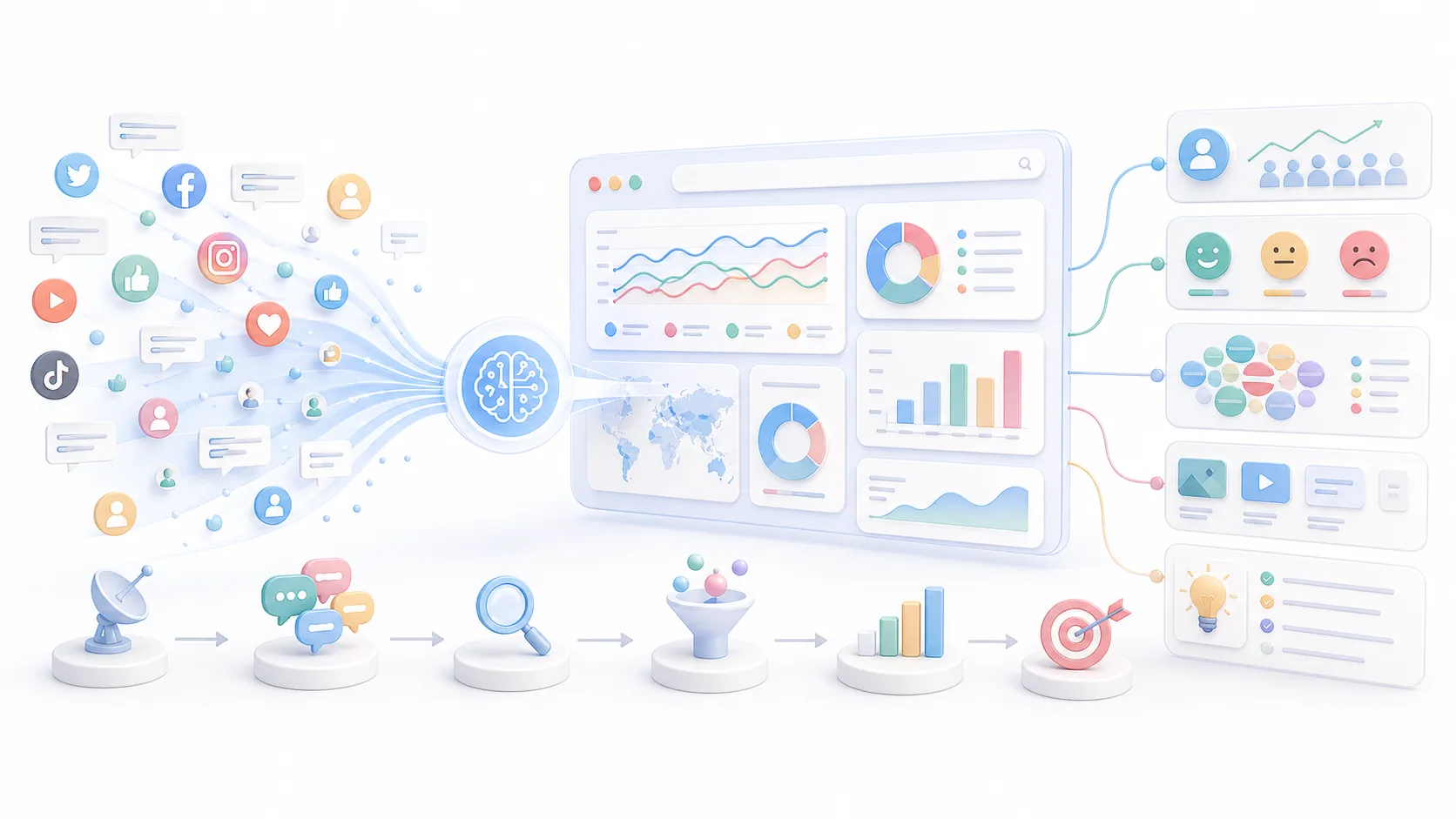
The Core Value and Strategic Significance of Social Listening
In the digital age, consumers generate enormous volumes of discussion on social media every day — from product usage experiences and service reviews, to brand evaluations and competitor comparisons. These organic discussions contain extraordinarily valuable market insights, but their dispersal across numerous platforms, diverse formats, and sheer volume make manual monitoring virtually impossible. Social listening tools exist precisely to solve this problem.
The strategic value of social listening spans multiple business dimensions. In brand management, it enables real-time tracking of brand volume, sentiment polarity, and trending topics, allowing teams to spot negative commentary early and execute countermeasures. In market research, it provides immediate, low-cost signals compared to traditional survey methods, uncovering organic consumer needs and pain points.
That said, when interpreting social data, several structural biases must be confronted head-on, or the analysis easily leads to wrong conclusions. The first is self-selection bias: people who actively post are usually a small minority with an especially good or especially bad experience, and the silent majority never gets recorded, so the sentiment ratio doesn't equal the actual distribution of customer satisfaction. The second is platform bias: user age, gender, and interest profiles vary widely across platforms, so monitoring only one platform means hearing only one segment of the audience. The third is non-human and unnatural traffic: bot accounts, sponsored posts, and coordinated posting inflate volume, and if not filtered out first, this artificial signal gets misread as genuine market reaction. The fourth is a limit on semantic interpretation: irony, memes, and insider slang frequently throw off automated sentiment classification. The practical approach is to position social listening as "a radar for surfacing issues and hypotheses" — once a signal worth pursuing is found, cross-validate it with surveys, interviews, or actual sales and complaint data, rather than making decisions on volume alone.
From a competitive analysis perspective, social listening allows enterprises not only to monitor their own brand but also to simultaneously track competitors' online volume and reputation, understanding competitors' strengths and weaknesses, market reactions to new product launches, and the considerations that drive consumers to choose between different brands. From a product development perspective, the usage feedback and feature suggestions that consumers share online are a valuable source of input for product improvement.
Social listening also plays a critical role in crisis early warning. By monitoring abnormal fluctuations in online sentiment in real time, companies can spot and intervene before a negative event spreads. Responding early matters because of how quickly social discussion spreads: early on, discussion is concentrated among a small number of nodes, when the cost of clarifying or correcting is lowest; once media outlets pick it up or large accounts cite it, the communication cost of the response rises sharply. As for "how much faster response reduces how much damage," there's no universally citable number — the impact depends on the nature of the event, the industry, the brand's existing trust level, and the content of the response itself; a poorly handled response can even amplify the spread. The practical approach is to build your own baseline: record the detection time, response time, peak volume, and the number of days it takes to subside for each incident. After accumulating several cases, you can derive the response-time-to-impact relationship specific to your own brand. Companies without a monitoring mechanism often don't find out until a situation has already escalated.
Data Sources and Collection Methods for Social Listening
Effective social listening requires broad data source coverage. In the Taiwan market, the primary data sources include: social media platforms (Facebook, Instagram, Twitter/X, LINE communities, Threads), forums and communities (PTT, Dcard, Mobile01, Bahamut), video platforms (YouTube comments, TikTok), news sites and blogs, and review platforms (Google Business Reviews, TripAdvisor, and product ratings across e-commerce platforms).
There are mainly two ways to collect data. The first is through the official APIs platforms provide: the data source is clear and the format is stable, but the access scope, retrospective period, and rate limits are all determined by the platform, and each platform's plans and terms can change at any time. The second is scraping data from public web pages: coverage is broader, but it's technically less stable and requires closer scrutiny of legality.
One caution: "using the official API" or "claiming to be compliant" doesn't by itself guarantee legality. A real assessment needs to separately examine at least four layers. First, whether the platform's terms of service and API license terms permit your company's intended use (for example, whether commercial analysis is allowed, whether storing original text is allowed, for how long, and whether it can be sublicensed to clients). Second, copyright: the original post text is someone else's copyrighted work, and reproducing large amounts of original text in a report is legally different from presenting only statistics, summaries, or links. Third, personal data protection: account names, avatars, and post content that can identify an individual are personal data, and collecting and using them requires a lawful basis along with adherence to purpose limitation and retention-period rules. Fourth, technical and contractual restrictions, such as whether login or protection mechanisms are bypassed. We recommend reviewing each data source against each intended use one by one and confirming with legal counsel; platform terms should also be periodically re-reviewed, since term changes aren't proactively announced to users. The actual scope of application and operational requirements should still be determined by the competent authority's latest announcements and your own company's legal counsel.
Keyword strategy design is the foundation of successful social listening. Enterprises need to build a comprehensive keyword framework that includes: brand names and their common variants (such as abbreviations, nicknames, and misspellings), product names, competitor brands and products, industry-related terminology, and specific topic keywords. Keyword strategy requires continuous optimization — regularly reviewing monitoring results to remove irrelevant noise data while incorporating newly emerged relevant terms.
Beyond text data, modern social listening systems can also handle brand recognition in images and videos (such as product photos and videos featuring a brand logo), as well as analysis of audio content (such as podcasts and voice-based social media). Multimodal data collection capabilities make social listening coverage significantly more complete.
Analysis Methods and Techniques for Social Listening
Collected data must be systematically analyzed to transform it into actionable insights. Sentiment Analysis is the most fundamental analytical dimension — classifying each mention as positive, negative, or neutral and tracking the trend of overall sentiment over time. An abnormal rise in the proportion of negative sentiment may signal an emerging brand crisis or product issue.
Topic Analysis uses NLP technology to automatically identify the main discussion topics and subtopics from large volumes of conversations. For example, when monitoring a smartphone brand, topic analysis might surface "battery life", "camera quality", "after-sales service", and "price positioning" as the primary discussion dimensions, along with the specific content and sentiment within each topic.
Trend Analysis tracks changes in volume and sentiment over time, helping enterprises understand the effectiveness of marketing campaigns, market reactions to product launches, and seasonal discussion patterns. Correlating volume changes with specific events (such as news coverage, marketing activities, and competitor moves) provides deep insight into the drivers of sentiment shifts.
Influence Analysis evaluates the most active or most influential accounts and content within a discussion, identifying key opinion leaders (KOLs) and potential brand advocates. These insights are extremely valuable for an enterprise's KOL marketing strategy and word-of-mouth marketing efforts.
Advanced analysis also includes audience analysis (understanding the demographic characteristics and interest profiles of the people participating in discussions), content analysis (identifying the most-engaged content types and modes of expression), and competitive benchmarking (comparing a brand's performance against competitors across various metrics).
From Insight to Action: Practical Applications of Social Listening
The ultimate value of social listening lies in driving concrete business actions. In marketing strategy optimization, social listening insights help marketing teams understand the issues their target audience cares most about and the language and expressions they use most often, enabling the creation of more resonant marketing content. Analyzing the response to competitors' marketing campaigns also provides valuable reference points for shaping one's own strategy.
In customer service, social listening can identify customers who have posted complaints or requests for help on social media in real time, enabling the customer service team to reach out proactively and resolve the issue. This "proactive customer service" approach not only resolves individual customer grievances but also demonstrates the brand's service ethos, winning goodwill from a broader audience of potential customers.
In product development, systematically collecting and analyzing the pain points, feature suggestions, and improvement requests that consumers share online can give product teams innovation ideas straight from users. The value of this "user-driven product development" approach lies in shortening the feedback loop, but social feedback also needs careful interpretation: the people who speak up aren't necessarily representative of the core customer base, and a loudly requested feature may come from just a small group of heavy users. We recommend treating social feedback as a candidate list, then prioritizing it using usage data, support ticket volume, and small-scale tests, and after shipping a change, tracking actual retention or satisfaction shifts to validate effectiveness with your own data.
To maximize the value of social listening, enterprises should establish regular reporting and insight-sharing mechanisms. Daily/weekly reports track changes in key metrics; monthly in-depth analysis reports explore trends and patterns; event-specific analysis reports are provided in real time when major public opinion events occur. Ensuring that insights reach the right decision-makers in a timely fashion is what ultimately enables genuine "data-driven decision making".
Key Criteria for Selecting Social Listening Tools
When selecting a social listening tool, data coverage is the primary consideration. For the Taiwan market, it is essential to verify whether the tool covers Taiwan-specific forums such as PTT, Dcard, and Mobile01, as well as high-usage platforms in Taiwan such as LINE communities. International brands need to assess whether the tool supports data collection from major global social platforms.
Analytical capability is another critical consideration. Has the tool's sentiment analysis been optimized for Traditional Chinese? Does it support automatic topic classification? Does it provide trend analysis and anomaly detection? Furthermore, the quality of data visualization (the intuitiveness and customizability of the dashboard) and report generation capabilities will directly affect day-to-day operational efficiency.
Real-time capability is critical for crisis early warning. An excellent social listening tool should be able to collect newly published content within minutes to hours of posting, and automatically send alert notifications (such as email or instant messaging push alerts) when an abnormal spike is detected. API and data export capabilities allow social listening data to be integrated into an organization's existing BI and CRM systems for deeper analysis and application.
Further Reading
FAQ
References
- Stieglitz, S., et al. (2018). "Social Media Analytics – Challenges in Topic Discovery, Data Collection, and Data Preparation." International Journal of Information Management, 39. DOI: 10.1016/j.ijinfomgt.2017.12.002
- Liu, B. (2012). "Sentiment Analysis and Opinion Mining." Synthesis Lectures on Human Language Technologies. Morgan & Claypool. DOI: 10.2200/S00416ED1V01Y201204HLT016
- Rathore, A.K., et al. (2017). "Social Media Content and Product Co-creation: An Emerging Paradigm." Journal of Enterprise Information Management. DOI: 10.1108/JEIM-06-2016-0098
Ready to Get Started with Social Listening?
Contact our team of experts to learn how InfoMiner can help you monitor your brand's online presence and market pulse in real time.
Contact Us