What is KYB? A Complete Guide to Business Credit Checks and Due Diligence
KYB (Know Your Business) refers to a due diligence process in which an enterprise verifies the identity of and assesses the risk of a counterparty before establishing business relations, extending credit, investing, or signing a contract. In contrast to KYC (Know Your Customer), which targets individuals, KYB focuses on legal entities, covering company basic information, ownership structure penetration, ultimate beneficial owner identification, related-entity networks, adverse media and litigation screening, and government tender award records. A thorough KYB process helps financial institutions, supply chain managers, and investors identify potential financial, compliance, and reputational risks. This article fully explains the definition of KYB, its core data dimensions, and use cases, and describes how LargitData supports business credit checks and due diligence with InfoMiner and RAGi.
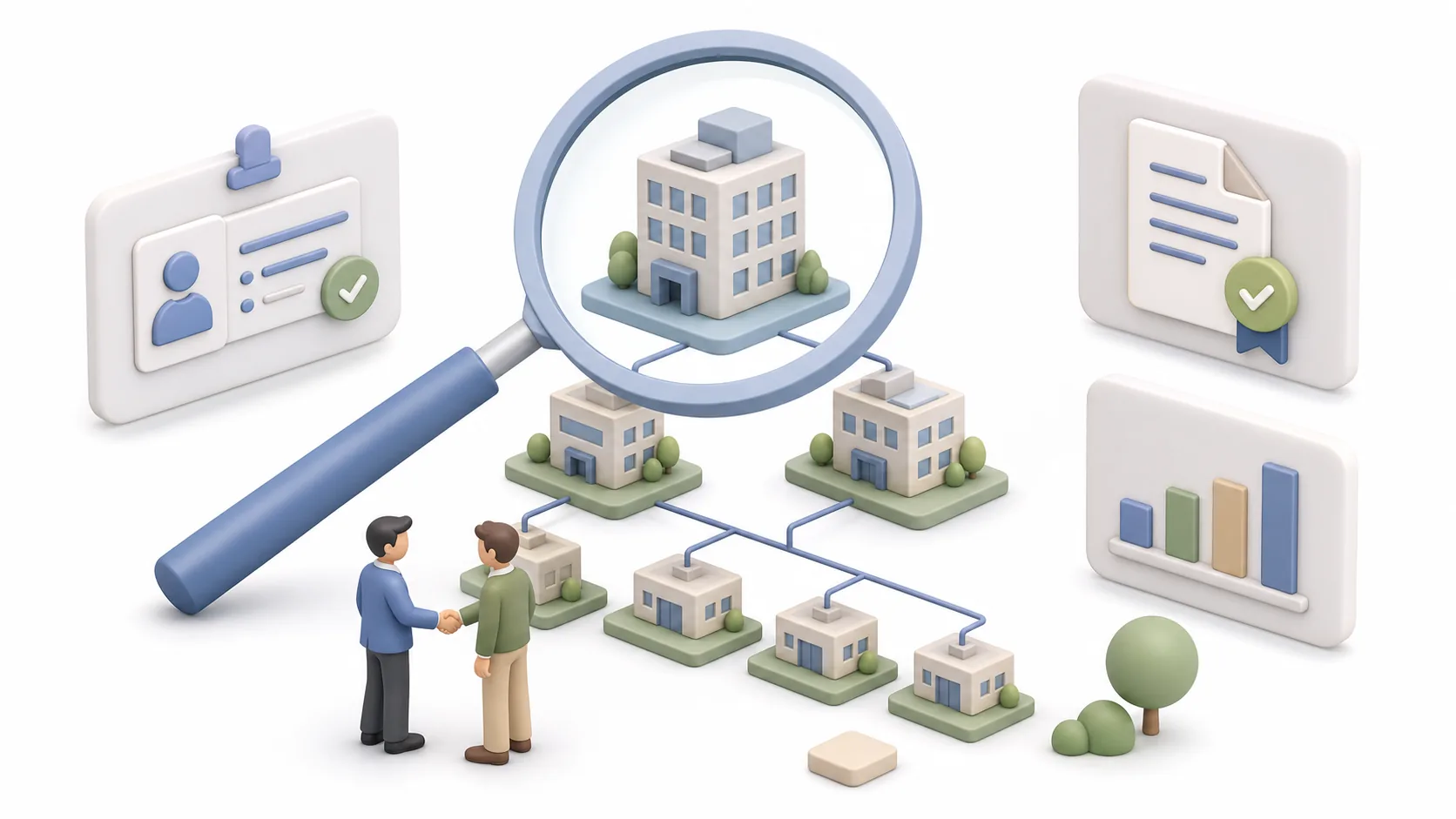
The Definition of KYB and Its Compliance Background
KYB (Know Your Business) is a critical pillar of Anti-Money Laundering (AML) and compliance frameworks. In Taiwan, the Money Laundering Control Act and regulatory rules establish obligations for financial institutions and designated non-financial businesses to perform customer due diligence, identify ultimate beneficial owners (UBO), and maintain ongoing monitoring; exact obligations, workflows, and record-keeping mandates vary by entity type, operational scope, and data processing roles. With heightened awareness of supply chain risks and ESG compliance, KYB adoption has expanded beyond finance into general enterprise vendor vetting, distributor management, and M&A due diligence, functioning as internal risk governance rather than statutory obligation.
If your business involves cross-border dealings, also keep in mind that thresholds for beneficial ownership, sanctions list applicability, and cross-border personal data transfer rules differ across jurisdictions — the same due diligence process may face different compliance requirements in different jurisdictions. Public information from Taiwan's Financial Supervisory Commission can serve as a starting point:Financial Supervisory Commission. The actual scope of application and operational requirements are still subject to the competent authority's latest announcements and the determination of your agency's (or company's) legal counsel.
Unlike traditional credit investigation reports, modern KYB emphasizes real-time timeliness and network relationality. Static point-in-time financial filings or registration records struggle to capture dynamic risks; through continuous ingestion of public information, sanctions list cross-referencing, and relationship network analysis, KYB delivers a dynamic, traceable risk posture (though data completeness remains bounded by source publication scopes and refresh frequencies).
The Core Data Dimensions of KYB
- Company basic information: unified business number, establishment date, capital, business scope, and registration status.
- Ownership structure penetration: tracing multi-layered ownership relationships to identify the ultimate controlling party and beneficial owner.
- Related-entity networks: revealing directors and supervisors, cross-shareholdings, and group relationships to uncover hidden connections.
- Adverse media screening: detecting public reports involving litigation, penalties, disputes, bankruptcy, and financial crises.
- Litigation and judgment records: querying commercial disputes and violation records in court judgment documents.
- Sanctions and watchlist screening: cross-checking against public sanctions lists such as OFAC, EU, and UN.
- Government tender award records: using public procurement data to assess an enterprise's track record and performance capability.
- Financial and operating indicators: referencing public financial reports and industry information to assess financial stability.
- Sentiment and reputational risk: monitoring brand volume and negative sentiment across social media and news.
Use Cases
- Financial institutions conduct business credit checks during credit, account opening, and counterparty reviews.
- Risk assessment by manufacturing and retail firms before onboarding new suppliers or distributors.
- Due diligence by investment institutions and private equity funds before M&A and investment.
- Corporate compliance and procurement departments establish supplier risk grading and periodic review mechanisms.
- B2B sales teams assess the payment ability and business reputation of potential clients.
Ownership Structure Penetration and Related-Entity Networks
Shareholding structure look-through is among the most technically demanding KYB capabilities. Many entities obscure ultimate controllers via multi-tiered holding layers, offshore shell companies, and nominee shareholders. By analyzing open corporate registries and directorship lists, KYB generates ownership relationship graphs within available and verifiable data, assembling candidate UBO lists layer by layer and flagging hidden linkages between ostensibly unrelated entities. These serve as investigative leads that do not substitute for formal UBO certification and statutory legal investigations.
There's no single answer to how many layers of look-through are enough, but in practice three conditions can help converge on a stopping point: first, the ownership stake falls below an internal threshold (a common approach is to flag paths with control below a certain percentage as secondary); second, tracing upward has reached a natural person, listed company, government body, or regulated financial institution — entities that can be treated as endpoints; and third, tracing has reached an offshore jurisdiction whose registration data isn't publicly disclosed. The third case should be explicitly recorded as “data unavailable” rather than treated as risk-free — this is exactly the point where manual lookup, requesting a client declaration, or outsourced inquiry is needed.
Another limitation that must be built into the methodology is the data-timeliness gap. Company registration changes have filing periods and processing time, sanctions lists are updated at different frequencies and sync schedules across systems, and court judgment disclosures also lag. In other words, every due diligence check is looking at a snapshot made up of data of varying ages. In practice, we recommend labeling the as-of date for each field in the report, and shortening the re-query cycle for high-risk subjects, rather than letting a single report date stand in for the timeliness of all the data.
False positives in name matching also need to be handled systematically. Chinese company names often share identical distinctive elements, involve Traditional/Simplified and variant characters, or have inconsistent old names versus English translations, and transliterations on sanctions and watch lists exist in multiple versions at once. Plain string matching produces a large number of false hits, so it's usually paired with fields such as unified business number, place of registration, incorporation date, and responsible person to improve identification, and stratified by similarity score: high scores trigger automatic hits, medium scores go into a manual review queue, and low scores are logged without triggering an alert. The disposition of false hits should be fed back into a whitelist to avoid the same subject repeatedly consuming staff time.
How the manual review threshold is set determines whether the whole process can actually be operationalized. A common approach is to set review intensity by risk tier: low risk gets sampled review, medium risk is confirmed case by case by frontline staff, and high risk is reviewed by compliance personnel who document their judgment in writing. The threshold should be periodically recalibrated against the actual false-positive rate and available staff capacity, with the reasoning for each adjustment recorded so that the origin of the tiering criteria can be explained during an audit.
Affiliated enterprise network analysis connects individuals, companies, and events. When a vendor's affiliates face litigation, sanctions, or adverse media, the transaction counterpart may face reputational or operational spillover; however, association alone does not establish illegality nor guarantee risk transmission. Visualizing connections as graphs helps decision-makers rapidly spot critical nodes requiring deeper inquiry, allowing human experts to evaluate whether such links carry material significance for the transaction.
Assessing Corporate Strength Using Government Tender Records
Government procurement award history is a valuable public data dimension in KYB. Government e-Procurement System notices enable querying award records, contract values, fulfillment records, and debarment statuses. For B2B decisions, procurement records serve as independent public evidence to cross-check self-reported track records against official notices; however, it covers only public sector engagements, and contract amounts represent contracted figures rather than actual realized revenue. It cannot independently verify holistic performance capacity, solvency, or client satisfaction without corroboration from financial reports, commercial contracts, and acceptance documentation.
Deployment Options and Data Governance Compliance
KYB platforms support cloud or on-premise deployments depending on operational needs. Cloud solutions offer rapid onboarding and low maintenance; on-premise architectures retain data processing and model inference within corporate intranets, tailored for financial institutions with heightened confidentiality demands. Data ingested for KYB must be confined to lawful public sources, backed by access controls, audit logging, and data retention/deletion policies to satisfy Taiwan PDPA and (where EU data subjects are involved) GDPR requirements; legal compliance must be verified against processing purposes, lawful bases, notification mechanisms, retention horizons, and cross-border transfer arrangements rather than assuming compliance merely from on-premise hosting or public data sourcing.
The actual scope of application and operational requirements are still subject to the competent authority's latest announcements and the determination of your agency's (or company's) legal counsel.
Further Reading
FAQ
Want to strengthen business credit check and due diligence capabilities?
Contact the LargitData expert team to learn how InfoMiner and RAGi can help you integrate KYB data, ownership penetration, and adverse media screening.
Contact Us Book a Demo