What is Threat Intelligence? A Complete Enterprise Guide to Threat Intel
Threat Intelligence (TI) refers to the methods and practices by which an enterprise or organization collects, aggregates, and analyzes external and publicly available information to identify, assess, and provide early warning of risks that may threaten its operations, assets, supply chain, or reputation. Threat intelligence spans cyber security threats (such as malware, APT attacks, and dark web intelligence), geopolitical risk, sanctions and compliance risk, and supply chain and counterparty risk. Effective threat intelligence turns scattered raw data into actionable decision support, enabling decision-makers to recognize warning signs before risks materialize. This article fully explains the definition of threat intelligence, OSINT data sources, sanctions screening, dark web monitoring, and geopolitical risk assessment, and describes how LargitData InfoMiner supports enterprises in building threat intelligence capabilities.
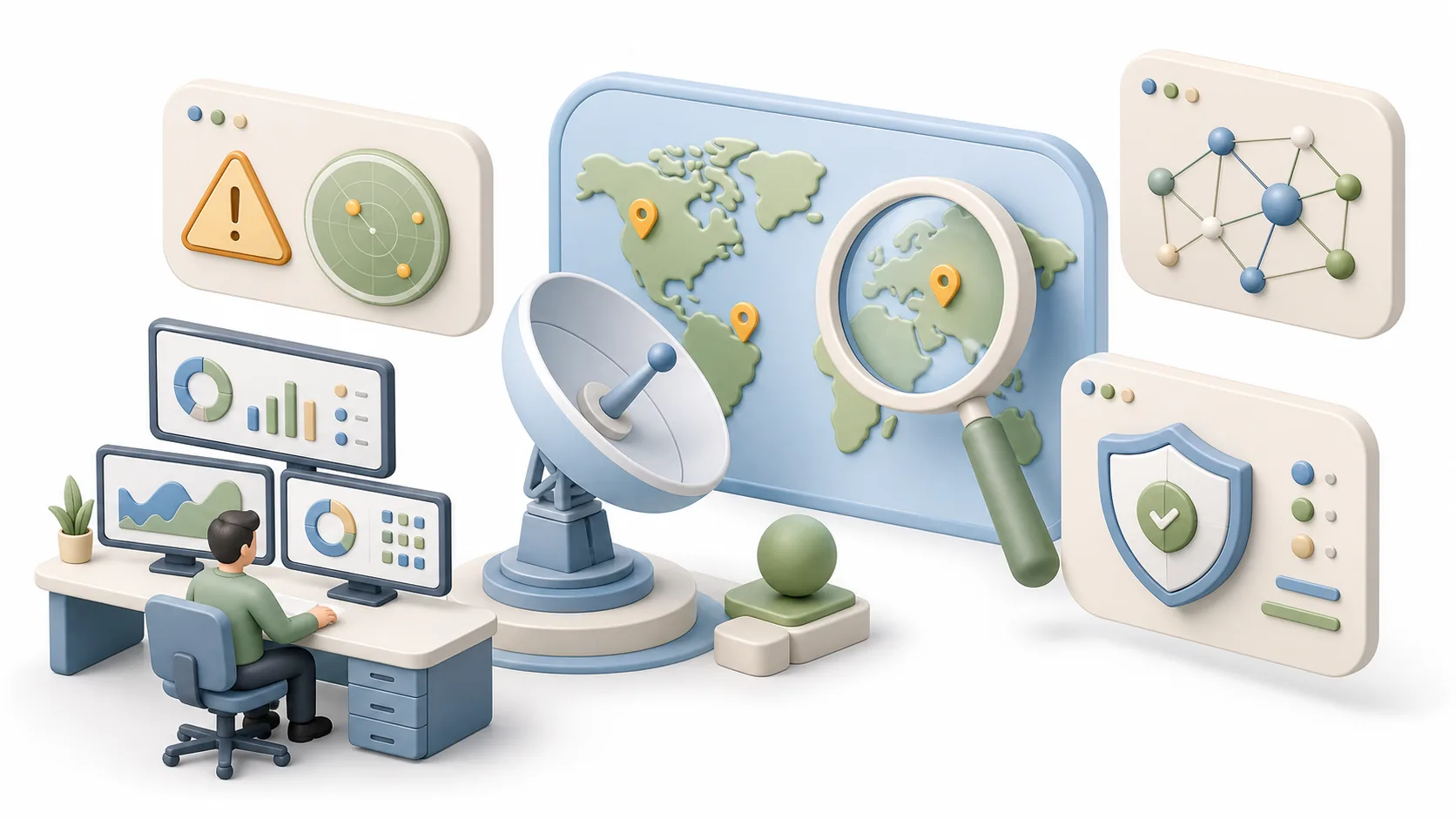
The Definition of Threat Intelligence and the Intelligence Cycle
Threat intelligence is not a single tool but a continuously operating intelligence cycle: from requirement definition, data collection, processing and aggregation, and analysis and assessment, through to intelligence output and feedback. Based on its own industry, supply chain structure, and regulatory environment, an enterprise defines the threat dimensions it needs to monitor, then uses automated collection and human assessment to distill vast volumes of public data into a small number of action-worthy alerts. Unlike traditional security tools that focus on events that have already occurred, threat intelligence emphasizes forward-looking early warning and situational awareness.
Threat intelligence is generally divided into three tiers: the strategic tier focuses on long-term trends and geopolitical risk to inform senior decision-makers' strategy; the operational tier focuses on the intent and tactics of specific threat actors; and the tactical tier focuses on concrete indicators of compromise (IoCs) and technical details that can be defended immediately. When adopting threat intelligence, enterprises should design intelligence outputs at the appropriate tier for each role's needs.
OSINT (Open Source Intelligence) and Data Sources
OSINT (Open Source Intelligence) is the most important foundation of threat intelligence. It refers to collecting intelligence from public, legally accessible sources, including news media, government announcements, court judgments, company registration data, social media, forums, professional databases, and public discussions on the dark web and deep web. The value of OSINT lies in its broad coverage, controllable cost, and its ability to be cross-validated with other intelligence sources to improve the credibility of assessments.
Common OSINT data sources include: mainstream news and industry media; public discussions on social platforms and online forums; announcements and sanctions lists from governments and regulators worldwide; public company registration and financial data; court judgment documents and litigation records; government procurement and tender public data; and threat indicators publicly shared by the security community. Enterprises should establish a standardized source whitelist and collection process to prevent noise from degrading assessment quality.
Key Capabilities of a Threat Intelligence Platform
- Multi-source automated collection: real-time gathering across news, social media, forums, government announcements, and public databases.
- Sanctions screening: cross-checking against public sanctions and watchlists such as OFAC, EU, and UN to identify sanctioned entities and related parties.
- Dark web and deep web monitoring: tracking public dark web discussions, data breach intelligence, and underground market activity.
- Geopolitical risk assessment: monitoring country risk, policy changes, and cross-border sensitive issues affecting the supply chain and operations.
- Adverse media and litigation screening: automatically detecting counterparties' disputes, lawsuits, penalties, and bankruptcy records.
- Entity relationship analysis: building relationship graphs among people, companies, and events to reveal hidden risk networks.
- Sentiment and anomaly-in-volume detection: using AI to interpret public sentiment and issue alerts before risks spread.
- Disinformation detection: identify false content spreading across platforms and trace its origin and diffusion path.
- Information Manipulation Assessment: Analyzing narrative framing, coordinated inauthentic behavior, and cross-platform propagation chronology.
- Anomalous account detection: expose troll armies, bots, and coordinated inauthentic behavior clusters.
- Alert grading and notification: automatically grading by risk level and pushing alerts to the responsible personnel.
- Continuous monitoring and timeline tracking: maintaining long-term observation of key subjects and recording how risk events evolve.
- Automated report generation: aggregating intelligence into readable risk reports that support decision-making and audit trails.
Use Cases
- Financial institutions screen sanctions lists and adverse intelligence during credit, KYC, and counterparty reviews.
- Manufacturing and technology firms assess suppliers' country risk, financial stability, and compliance records.
- Government agencies and critical infrastructure operators conduct continuous monitoring of geopolitical and cyber security threats.
- Public sector and critical infrastructure units detecting disinformation, narrative manipulation, anomaly accounts, and coordinated inauthentic behavior.
- Due diligence before M&A and investment, understanding the potential risks of the target company.
- Compliance and audit teams establish verifiable, traceable risk review processes.
Sanctions Screening and Dark Web Monitoring
Sanctions list screening is among the threat intelligence capabilities most frequently integrated into compliance architectures. The US Department of the Treasury Office of Foreign Assets Control (OFAC) Specially Designated Nationals (SDN) list, European Union sanctions, and United Nations consolidations represent authoritative open sources. Screening prospective counterparties mitigates unlawful transaction exposure; however, screening alone does not guarantee immunity from statutory penalties. Sanctions liability turns on jurisdiction, underlying commercial transactions, physical and financial flows, corporate control structures, and ultimate beneficial ownership (UBO)—compounded by watchlist update latency and homonym ambiguity.
Consequently, screening system engineering must minimize false negatives and false positives: parsing name aliases and transliteration variants, unwrapping corporate shareholdings and ultimate control chains, archiving human review logs for auditability, and verifying upstream list refresh intervals. Specific regulatory scopes and operational mandates must be validated against official regulatory directives and internal legal/compliance determinations.
Dark web monitoring targets unindexed cyber domains. Breached credentials and exfiltrated datasets surface across diverse channels: paste sites, code repositories, cloud file-sharing services, encrypted messaging channels, and underground illicit forums. The order and visibility of exposures vary unpredictably by incident; avoid assuming leaks 'always surface on the dark web first' and monitoring only a single channel archetype.
A defensible approach runs parallel monitoring across open web sources and underground marketplaces, executing persistent watchlists against corporate identifiers (domains, internal hostnames, executive names, and confidential project codenames). Teams must anticipate high signal-to-noise ratios: alerts require human triage to verify breach authenticity, incident attribution, and blast radius—preventing false alarms from overwhelming security operations teams.
Geopolitical Risk and Supply Chain Intelligence
Geopolitical risk is especially important for Taiwanese enterprises. Changes in cross-strait relations, international trade policy, technology controls, and export controls can all disrupt the supply chain and markets within a short time. By continuously monitoring policy announcements, international news, and industry developments across countries, threat intelligence helps enterprises assess country risk in advance, identify affected supply nodes, and plan alternatives. Combining geopolitical intelligence with supply chain data shifts risk management from reactive response to proactive positioning.To systematically map global geopolitical events against corporate operating sites, vendor ecosystems, and customer exposure matrices, refer toInfoMiner Global Situation and Risk Intelligence Platform。
Deployment Options and Data Governance
Threat intelligence platforms support cloud or on-premise deployments depending on security postures. Cloud deployments deliver rapid onboarding and low maintenance overhead suitable for commercial enterprises; on-premise deployments retain data processing and model inference within proprietary network perimeters, tailored to public agencies, high-tech manufacturing, and financial institutions requiring strict data sovereignty. LargitData offers on-premise architectures (RAGi On-Premise and QubicX On-Premise AI Platform) to satisfy zero-data-egress compliance.
We must clearly articulate on-premise security boundaries: running inference in an intranet removes the 'transmitting data to third-party clouds' vector, but does not render systems immune to exfiltration. Software/model updates, vendor remote support tunnels, telemetry/crash reporting, backup media, over-privileged internal accounts, and manual data exports remain distinct risk vectors requiring granular controls. On-premise deployments must be coupled with rigorous data flow inventories, maintenance tunnel access controls, telemetry opt-outs/whitelists, encrypted backup protocols, least-privilege RBAC, and comprehensive audit logging.
Regarding data governance, threat intelligence gathering should be restricted to publicly accessible information while enforcing access control policies, audit logging, and data retention rules. We must dispel a common misconception: 'publicly accessible' data cannot be collected, stored, and redistributed unconditionally. Sourcing legality must be validated per source across four dimensions: platform terms of service regarding automated scraping, content copyright scopes, personal data compliance (whether processing falls within strictly necessary statutory boundaries), and cross-border data transfer restrictions.
Operationally, maintain a Data Source Lineage Registry documenting acquisition methods, statutory/terms basis, refresh frequencies, PII inclusion, retention limits, and disposal mechanisms, preserving immutable source citations across deliverables. The EU General Data Protection Regulation (GDPR) carries extraterritorial jurisdiction when processing EU data subjects—requiring heightened compliance during cross-border threat intelligence collection. Compliance obligations remain governed by regulatory notices and corporate legal determinations.
Further Reading
FAQ
Practical boundary guidelines: passively monitor only publicly visible content, never attempt unauthorized access, never participate in monetary transactions or negotiations on illicit forums, enforce strict data minimization and encryption on personal data, and maintain immutable operational audit logs for compliance auditing. Such intelligence gathering should be entrusted to teams with established standard operating procedures and prior legal sign-off. Compliance mandates remain subject to official regulatory announcements and corporate legal counsel determinations.
Want to build enterprise threat intelligence capabilities?
Contact the LargitData expert team to learn how InfoMiner and RAGi can help you integrate threat intelligence, sanctions screening, and supply chain monitoring.
Contact Us Book a Demo