Multi-Agent System: A complete beginner's guide to enterprise AI architecture built on multi-agent collaboration
A Multi-Agent System (MAS) is one of the design directions that has drawn significant attention in enterprise AI architecture in recent years. When a single AI agent hits a bottleneck in context capacity or task complexity, an architecture where multiple specialized AI agents collaborate becomes a viable alternative, though it also brings significantly higher engineering and operational costs. This article starts from the core concepts and dives into the Orchestrator-Worker coordination architecture, inter-agent communication mechanisms, fault-tolerance design, enterprise adoption considerations, and the trade-offs among common frameworks such as AutoGen, CrewAI, and LangGraph, helping enterprise technical decision-makers establish the right evaluation methods and expectations before investing.
Core concepts of Multi-Agent Systems
The concept of Multi-Agent Systems (MAS) originates from Distributed AI research, but it has gained an entirely new technical implementation path in the LLM era. In an LLM-driven Multi-Agent System, each agent is an independent AI reasoning unit with its own role and scope of capability defined by a system prompt, its own toolset, and its own local memory; multiple agents work together through message passing and task coordination mechanisms to accomplish a complex goal that exceeds the capability of any single agent.
Why do we need multiple agents instead of one more powerful single agent? The answer lies in the trade-offs of complex system design, not in multi-agent architectures being inherently stronger. The first common motivation is the "context window limit": even the most advanced LLMs have an upper bound on how much information they can process in a single inference pass. For tasks that require handling large volumes of documents or long-running workflows simultaneously, a single agent often cannot fit all the necessary information into one context. Having multiple agents split the work across different data shards and then pass the results to an aggregating agent is one way to work around a single context limit, but note that this doesn't eliminate the constraint — it merely shifts it to two new information bottlenecks: "summary compression" and "cross-agent handoff". Every summary a worker hands off to the orchestrator is a lossy compression, and whether key details are preserved needs to be verified through actual testing, not guaranteed by the architecture.
The second motivation is "specialization": specialized agents designed with role prompts, toolsets, and few-shot examples tailored to a specific task have a chance to outperform a general-purpose agent that tries to handle everything, but this isn't guaranteed — when subtasks require a large amount of shared context, splitting them apart can instead leave each agent lacking the full picture needed to make good judgments. The third motivation is "parallel processing": multiple agents can work on mutually independent subtasks at the same time to reduce wall-clock time, provided the subtasks are genuinely independent and the system's bottleneck isn't the API rate limit or a downstream database. The fourth motivation is "cross-checking": having a reviewer agent audit a writer agent's draft can catch some obvious errors, but the reviewer is itself an LLM and can equally miss issues or introduce new hallucinations, so what it reduces is the probability of a single point of failure, not a guarantee of correctness.
The correct evaluation approach, therefore, is to first establish a measurable baseline with a single agent (task success rate, end-to-end latency, token cost per task, and the rate of required human intervention, all on the same set of task samples), then compare the candidate multi-agent architecture on that same sample set. If the improvement in success rate from the multi-agent version is smaller than the increase in cost and latency, then the architecture isn't worth adopting for that scenario. Without this kind of comparative data, any claim that "multi-agent is better" is nothing more than an assumption.
The role architecture of orchestrators and workers
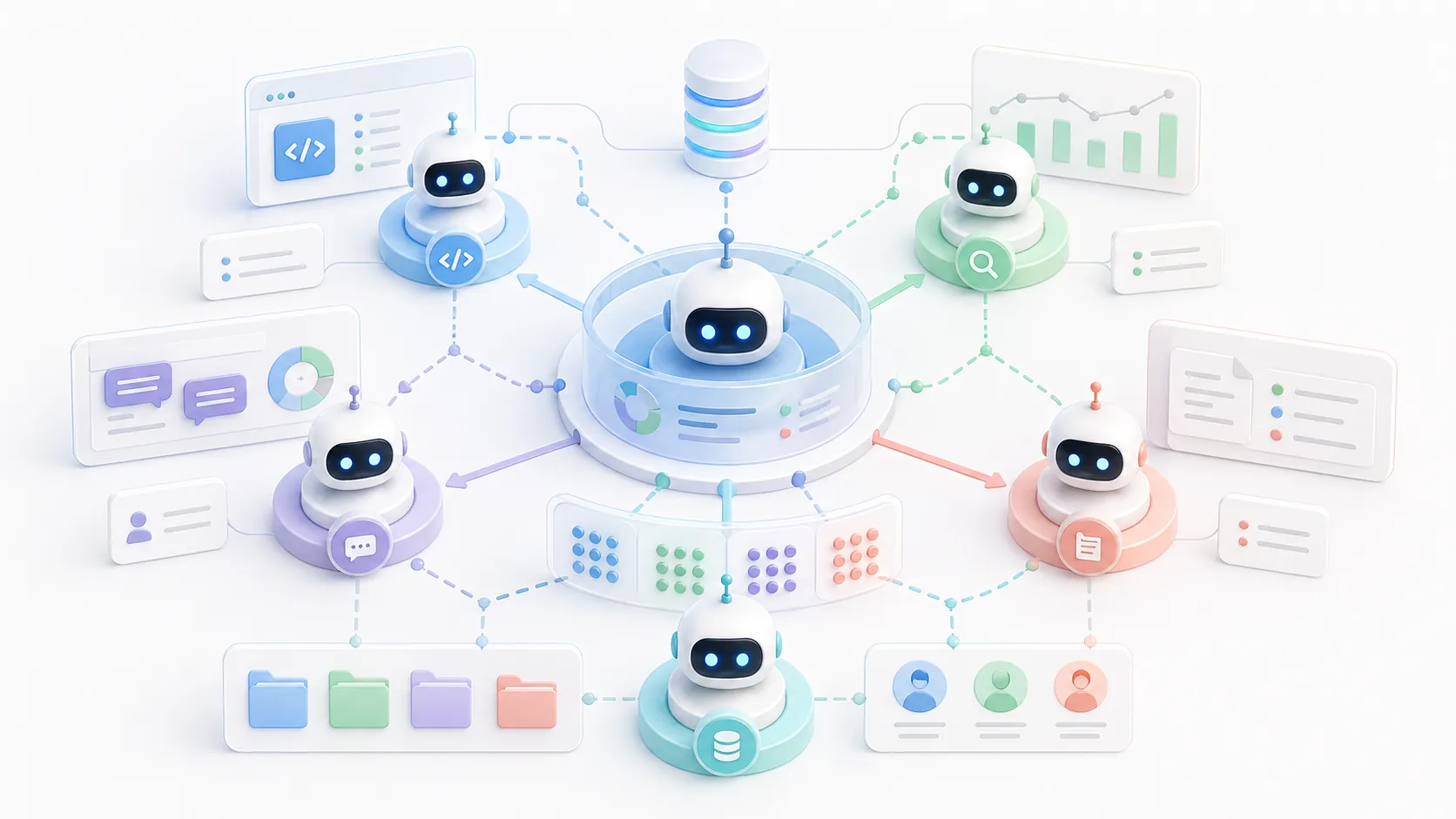
In practical discussions, the Multi-Agent architecture most often mentioned is the "Orchestrator-Worker" pattern, which is one common design option, not the only one or necessarily the best. In this architecture, the orchestrator agent plays the role of a project manager: it receives the top-level task goal, breaks it down into multiple subtasks, assigns each subtask to the most suitable worker agent, tracks execution progress, integrates the outputs of the various worker agents, and re-plans the task flow when necessary. Worker agents, on the other hand, are specialized executors in their respective domains; each worker focuses only on the subtask assigned to it and reports the result back to the orchestrator upon completion.
Take a "product analysis report generation" Multi-Agent system as an example — a complete division of roles might look like this: the Orchestrator Agent receives the instruction "analyze competitor A's latest product strategy" and breaks the task down and assigns it to: a Search Agent (performs web searches, collects related news and announcements), a Data Agent (queries the internal database, extracts historical sales comparison data), an Analysis Agent (takes the output of the previous two agents and performs in-depth analysis and insight extraction), a Writer Agent (drafts a structured report based on the analysis results), and a Review Agent (checks the report for accuracy and logical soundness and suggests revisions); finally, the Orchestrator compiles the final report.
Besides the Orchestrator-Worker pattern, another common architecture is the "Peer-to-Peer" pattern, suited to scenarios where multiple agents need to debate each other or examine a problem from different angles. For example, in a legal document review system, one could design an "Advocate Agent" (looks for interpretations favorable to the company) and a "Scrutiny Agent" (identifies potential risks and unfavorable clauses); the differing viewpoints of the two agents are then synthesized by an "Arbitration Agent" to provide a more comprehensive and balanced analysis.
Inter-agent communication and task allocation
The performance of a Multi-Agent System depends heavily on the design quality of its inter-agent communication mechanism. There are currently two main communication modes: "synchronous communication" (an agent sends a request and waits for another agent's response before continuing) and "asynchronous communication" (an agent sends a request and continues with other work, processing the response when it arrives). Synchronous mode is used for flows that must execute in strict sequence, while asynchronous mode is used for subtasks that can be processed in parallel to improve overall efficiency.
Task allocation is also a core architectural design challenge. Static task allocation (pre-defining which agent handles each type of task) is simple to implement and predictable in behavior, making it suitable for scenarios with stable workflows; dynamic task allocation (where the orchestrator decides the best-suited agent in real time based on the specific needs of the current task) offers greater flexibility but adds system complexity and uncertainty. A common compromise is a hybrid strategy: use static allocation for known, high-frequency core flows to gain predictability, and open up dynamic allocation only for long-tail and edge cases.
Standardizing message formats is a design decision that is often overlooked but critically important. Messages passed between agents should use a structured format (such as JSON Schema) with clearly defined fields, avoiding the use of plain natural language to convey key business information. A standardized message format improves the reliability of inter-agent communication and makes system logs easier to interpret and debug. It's worth noting that having structured messages is not the same as having audit-ready records. For an execution history to genuinely serve as audit evidence, additional design is needed: a trace ID that runs through the entire task along with the causal relationships between each step, a tamper-resistant (append-only or hash-chained) storage mechanism, clear retention periods and deletion policies, indexes that can be queried by person/time/data subject, and a permission trail that records "which identity authorized which tool call." These controls need to be verified item by item against the regulations applicable to your company; the architecture itself cannot satisfy them on your behalf.
Fault tolerance and system reliability
Fault tolerance is a key challenge in taking a Multi-Agent System from the lab into a production environment. In a system where multiple agents collaborate, the failure of any single agent can affect the completion of the overall task, so a well-designed fault-tolerance strategy is essential.
A retry policy is the most basic fault-tolerance design. When a worker agent fails to execute (for example, a tool call times out or the LLM API is temporarily unavailable), the system should automatically retry 1-3 times before determining a failure. The retry interval typically uses an exponential backoff strategy to avoid repeated retries adding further load when a service is already overloaded. If retries still fail, the system needs to decide: whether a backup agent can perform the same task, whether it can degrade gracefully (execute a simplified version of the task), or whether it must trigger human intervention.
Task state persistence is another key design element. Task execution in a Multi-Agent system may last minutes or even hours, so the system must persistently store the execution state, intermediate outputs, and checkpoints of each subtask, allowing a task to resume from the most recent checkpoint after an interruption rather than starting over from scratch.
In terms of monitoring and observability, a Multi-Agent System needs more thorough logging and tracing than a single agent. The decision-making process, tool call records, and message-passing history of every agent should be fully logged and linked to a shared execution trace ID for the task. This gives engineers a better chance of pinpointing which agent and which step a problem occurred in when a task execution goes wrong. To make observability genuinely effective, a few common pitfalls also need attention: if logs only record the final output without capturing the full prompt sent to the model and the tool return values, most hallucination-related issues cannot be reproduced; if trace data is sent to an external SaaS observability platform, that's effectively carrying prompt content and possibly personal data outside the enterprise boundary, which needs to be included in your data-flow inventory; and when the sampling rate is set too low, low-frequency but high-impact failures often end up being exactly the ones that go unrecorded.
Enterprise considerations for adopting Multi-Agent systems
When evaluating whether to adopt a Multi-Agent System, enterprises need to face several challenges and considerations that are quite different from those of a single agent. Complexity management is the primary challenge: debugging a Multi-Agent System is far harder than debugging a single agent, because a problem could originate in any one agent's logic, any communication path, or any tool integration point. It's advisable to start with a small-scale architecture of 2-3 agents, validate and test it thoroughly, and then expand step by step.
Cost control is another key consideration. Every agent in a Multi-Agent System needs to call an LLM API, so total inference cost grows quickly with the number of agents and task complexity. Cost optimization strategies include: using a stronger flagship model for the orchestrator (such as GPT-5.6 Sol or Claude Opus 5) while switching worker agents to lower-priced lightweight models (such as GPT-5.6 Luna, Claude Haiku 4.5, or Gemini 3 Flash); implementing a caching mechanism (not calling the LLM again for the same subtask); and periodically assessing whether each agent genuinely needs LLM inference, since some rule-based tasks can be replaced with deterministic code instead of an LLM call. When estimating cost, keep in mind that a multi-agent architecture's token usage is not simply a linear sum of the number of agents: the orchestrator has to re-read the accumulated state and each worker's report every single round, and this portion of input tokens grows with the number of rounds — it's usually the main cause of runaway budgets. It's advisable to log input/output tokens round by round for representative tasks during the PoC stage, and then estimate cost by multiplying your own usage by each vendor's currently published rate.
Security and permission management are especially important in a Multi-Agent System. Every agent should follow the "principle of least privilege": it should only be able to call the tools and data sources necessary to complete its assigned task. The orchestrator agent should not hold access permissions for all tools; instead, specific tool-usage permissions should be dynamically granted to worker agents as needed. For enterprises handling sensitive data, deploying the LargitData QubicX on-premise AI platform is worth evaluating, keeping an agent's model inference and vector retrieval running within the enterprise's own environment and avoiding sending prompt content to an external API. That said, on-premise deployment by itself doesn't mean data never leaves the organization: you still need to separately inventory which fields are exposed by the external tools an agent can call (web search, third-party APIs), where observability and telemetry data is sent, where backups and disaster-recovery copies are stored, and where model and dependency updates come from. A practical approach is to draw a data-flow diagram for each agent, mark exactly where it crosses the enterprise boundary, and use that to decide which tools need to be masked, proxied, or outright disabled.
Typical use cases and benefit analysis
Multi-Agent Systems have a better chance of demonstrating value on complex tasks that require "parallel processing" or "collaboration across multiple specialties." Below are several enterprise use cases that come up frequently in discussion, along with how to measure results for each:
Software development automation
Software development is one of the areas where multi-agent architectures have been prototyped the most. A typical architecture includes: a Requirements Analysis Agent (converts requirement documents into technical specs), a Code Generation Agent (generates code from the specs), a Testing Agent (generates and runs unit tests), a Code Review Agent (checks code quality and security vulnerabilities), and a Documentation Agent (automatically writes API documentation). Steps that are independent of one another can run in parallel. To judge whether this genuinely speeds up delivery, what's worth measuring isn't "time to generate code" but the overall lead time "from requirement intake to merge into the main branch," while also tracking code review rejection rates and post-release defect density. If generation gets faster but the rejection rate rises at the same time, overall time may stay the same or even get worse. The actual magnitude depends heavily on existing test coverage, codebase size, and the quality of spec documents, so you should run a before/after test on your own project rather than citing someone else's multiplier.
Large-scale document analysis
Legal due diligence requires analyzing hundreds of contract documents to look for risk clauses and key obligations. A Multi-Agent system can assign documents to multiple analysis agents running in parallel, with each agent responsible for a batch of documents; upon completion, identified risk points are reported to an Aggregator Agent, and a Summary Agent ultimately produces a consolidated risk report, letting professionals focus their time on judgment and supplementary work rather than paging through documents one by one. The key metric for this kind of application is recall, not speed: the cost of missing one significant unfavorable clause far outweighs the reading time saved. You must therefore first build an evaluation set of contract samples already annotated by lawyers, measure the system's miss rate across different types of risk clauses, and keep human review as a mandatory step. Time saved should be measured empirically on your own samples, not by applying a generic multiplier.
End-to-end business process automation
Complex end-to-end business processes (such as insurance claims processing, procurement approval, or new-customer account opening) span multiple departments and multiple systems, and are a scenario where multi-agent architectures are more commonly evaluated. Different agents each handle the business logic of a different department, coordinating through a standardized message format to reduce the waiting and duplicate data entry involved in manual handoffs. These kinds of processes usually involve regulated operations, so the design should retain human approval checkpoints at steps with real legal or contractual consequences, and establish a queryable execution record for every checkpoint. It's worth noting that having an execution record is only a prerequisite for an audit — whether it actually satisfies applicable regulations still depends on requirements such as the control objective, log completeness, retention period, and tamper-resistance. The actual scope of applicability and operational requirements should still be determined by the latest announcements from the competent authority and your company's legal counsel.
LargitData's RAGi platform offers the ability to build Multi-Agent workflows: enterprises can define agent roles, tool configurations, state transitions, and human-review checkpoints through a visual design interface, and obtain a step-by-step execution trace, without having to build an agent communication and state-management framework from scratch. The actual list of supported tools, state-management capabilities, and observability interface vary by version, so it's advisable to request the current feature documentation and verify it in a demo environment during your adoption evaluation.
Further Reading
- What Is an AI Agent? Principles, Architecture, and Complete Analysis of 2026 Enterprise Applications
- The Complete Guide to AI Agent Enterprise Use Cases: 10 Real-World Implementations and ROI Analysis
- What Is RAG? The Principles, Architecture, and Enterprise Applications of Retrieval-Augmented Generation
FAQ
Want to learn how to build a Multi-Agent system for your enterprise?
LargitData's AI engineering team can support enterprises across the entire process — from requirements analysis and architecture design to building evaluation sets, system launch, and operations handover — providing full technical support, and helping to clarify upfront whether a multi-agent architecture is genuinely necessary before adoption.
Consult on a Multi-Agent system solution