What Is RAG? The Principles, Architecture, and Enterprise Applications of Retrieval-Augmented Generation
Retrieval-Augmented Generation (RAG) is an AI architectural pattern combining information retrieval with Large Language Models (LLMs), allowing AI systems to reference real-time, authoritative information from external knowledge bases during generation. When retrieval relevance, reranking strategies, and citation conditioning are properly engineered, RAG mitigates model hallucinations and grounds responses in verifiable source citations relevant to proprietary enterprise domains. However, RAG is not an unconditional silver bullet: if retrieval fails to extract relevant passages, models may still confabulate answers. This guide explores RAG architectures, technical mechanics, enterprise use cases, and measurable frameworks for evaluating and implementing RAG platforms.
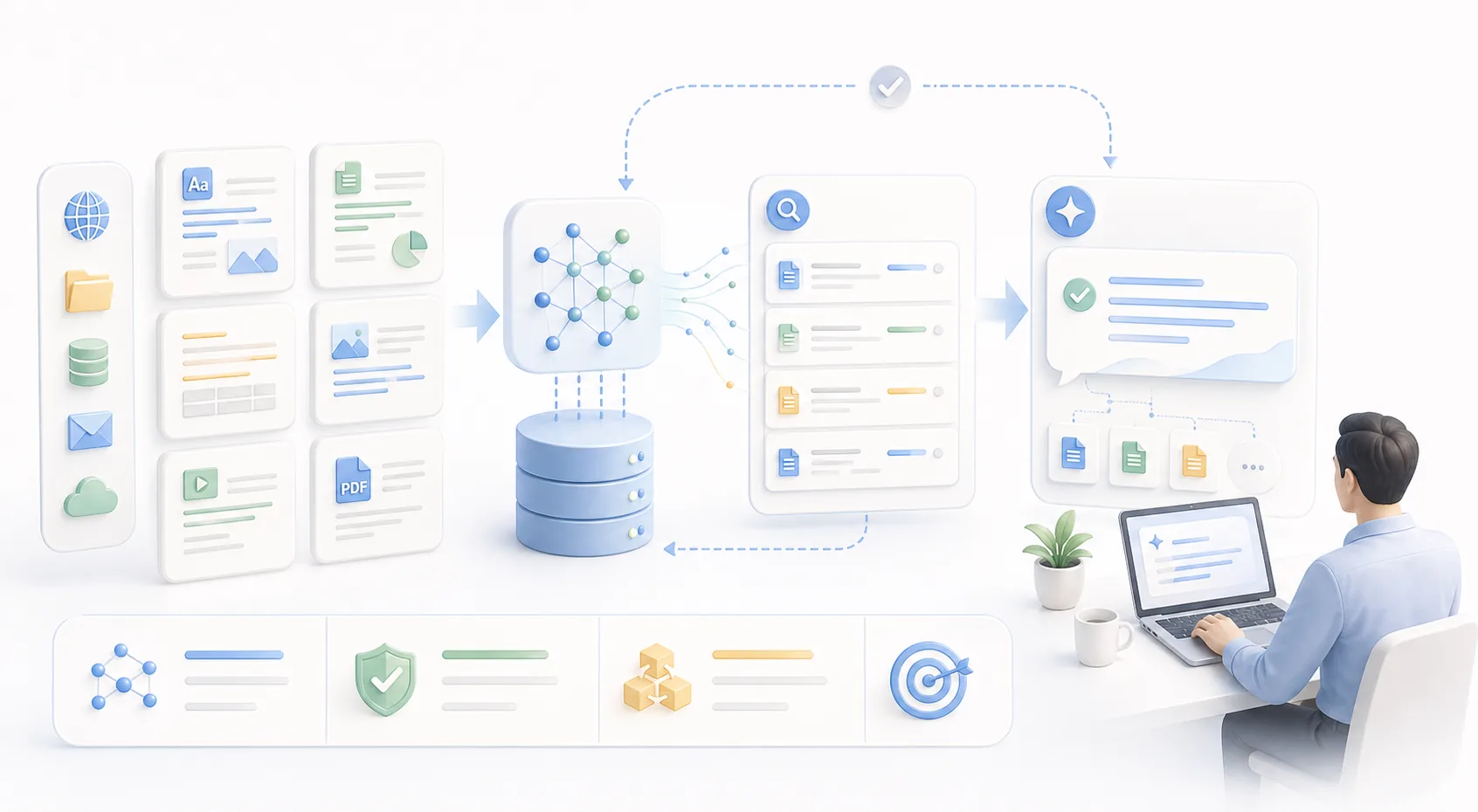
Technical Principles and Operating Mechanisms of RAG
The core concept of RAG can be understood through a simple analogy: a traditional large language model is like a knowledgeable expert who can only answer questions from memory, while RAG is like a researcher who can consult a database at any time — before answering a question, they first search for relevant materials, then formulate a precise answer based on what they find.
The RAG workflow is divided into three main stages. The first stage is Indexing: the system splits the enterprise's knowledge documents (files, manuals, regulations, FAQs, etc.) into appropriately sized text chunks, converts each chunk into a high-dimensional vector representation (vector embedding) through an embedding model, and stores them in a vector database.
The second stage is Retrieval: when a user poses a question, the system converts the question into a vector representation and performs a similarity search in the vector database to find the text chunks most relevant to the question. Common similarity calculation methods include Cosine Similarity and Euclidean Distance. Advanced RAG systems also combine keyword search, semantic search, and hybrid search strategies to improve retrieval recall and precision.
The third stage is Generation: the system combines the retrieved relevant text chunks with the user's original question to form a prompt, which is sent to the large language model for answer generation. Because the language model has reliable reference material when generating the response, it produces answers that are more accurate, more specific, and grounded in evidence. The system can also annotate the source documents cited in the answer, making the response fully traceable.
What Core LLM Problems Does RAG Solve?
Large language models are powerful, but they face several key challenges in enterprise applications. The first is 'hallucination': an LLM may generate information that sounds plausible but is actually incorrect, and in specialized domains like law, medicine, or finance, such errors can have serious consequences. RAG can reduce some hallucination by grounding the model's answers in retrieved, real source material and requiring the output to cite the passages used, but the effect has limits and preconditions: when the retrieval stage fails to surface the correct passage, the model will often still answer from its existing memory anyway; and when multiple retrieved documents contradict each other (for example, an old and a new version of a regulation both existing at once), the model may also pick the wrong one as its basis. So truly reducing hallucination takes three additional things beyond just adding RAG: first, building 'whether the answer can actually be derived from the cited passages' into automated evaluation; second, having the system explicitly say no data was found rather than forcing an answer when retrieval confidence is low; and third, continuously cleaning outdated and duplicate documents out of the knowledge base.
The second challenge is knowledge currency: an LLM's knowledge is limited to the cutoff date of its training data and cannot answer questions about recent events or up-to-date information. RAG addresses this by retrieving the latest knowledge base content in real time, enabling the AI system to access and utilize current information. Enterprises simply update the documents in the knowledge base — no retraining of the entire language model is needed.
The third challenge is domain expertise: general-purpose LLMs have limited knowledge of specific industries or individual enterprise operations. RAG connects the AI system to the enterprise's internal knowledge base, enabling it to accurately answer specialized questions about products, processes, and policies — creating a truly enterprise-grade AI assistant.
Fourth, RAG changes how sensitive data is handled: enterprises don't need to hand internal documents over for model fine-tuning; instead, they stay in the organization's own knowledge base and are retrieved for reference only when needed. It's worth noting that this changes the data flow during the 'training stage' only — it doesn't mean data never leaves the organization at all: retrieved passages are still placed into the prompt sent to the generation model, and if that model is an external API, the sensitive passage has already left the enterprise boundary. The actual data-exfiltration risk depends on several independent decisions: whether the embedding model runs locally or calls an external service, whether the generation model is on-premise or cloud-based, whether prompts and responses are logged on a third-party observability platform, where the vector database and backups are stored, and whether retrieval enforces the same access permissions as the original documents (otherwise you get unauthorized reads where 'asking a question bypasses file permissions'). To reduce risk, these five items need to be inventoried and controlled individually, rather than assuming the RAG architecture itself is inherently secure.
RAG System Architecture Design and Best Practices
Building a high-quality RAG system requires careful design at multiple stages. In the document processing phase, the choice of text chunking strategy is critical. Chunks that are too large may contain too much irrelevant information, reducing retrieval precision; chunks that are too small may lose contextual coherence, degrading answer quality. Common chunking strategies include fixed-size chunking, sentence-level chunking, paragraph-level chunking, and semantics-based intelligent chunking.
The choice of embedding model directly affects retrieval quality. Multilingual embedding models such as multilingual-e5 and BGE-M3 are especially important for enterprises that need to process documents mixing Chinese and English. Furthermore, fine-tuning an embedding model for a specific domain can further improve retrieval relevance.
Advanced RAG architectures also incorporate several optimization techniques: Query Rewriting improves retrieval effectiveness by reformulating the user's question; Re-ranking performs a secondary sort on initial retrieval results to surface the most relevant chunks; Context Compression reduces redundant information in retrieved results; and Multi-hop Reasoning enables the system to handle complex questions that require synthesizing information from multiple documents.
Diverse application scenarios
Intelligent customer service is one of the most mature enterprise application scenarios for RAG. Traditional chatbots can only handle pre-programmed FAQ responses, whereas a RAG-based intelligent customer service system can understand users' natural language questions, retrieve relevant information from knowledge bases comprising product manuals, terms of service, and past cases, and generate accurate, context-aware responses — significantly improving service quality and efficiency.
Enterprise knowledge management is another high-value application domain. Large enterprises typically possess enormous volumes of internal documents, technical documentation, and standard operating procedures, and employees often struggle to quickly locate the information they need. A RAG system can serve as the enterprise's intelligent search engine, allowing employees to obtain accurate answers through natural language queries — with links to source documents included — dramatically improving knowledge worker productivity.
In legal, compliance, and audit contexts, RAG systems help professionals quickly look up regulatory provisions, case law, compliance guidelines, and generate summaries or comparative analyses. In healthcare, RAG can assist medical staff in querying the latest clinical guidelines and pharmaceutical information. In financial services, RAG is used for investment research, risk assessment, and regulatory compliance.
How to Evaluate and Select a RAG Solution
When evaluating RAG solutions, enterprises should consider the following dimensions. First, answer quality: are the system's responses accurate, complete, and relevant to the question? Has it effectively reduced hallucinations? Second, retrieval performance: can the system quickly find the most relevant information within a large document corpus? Does it support a full range of document formats (PDF, Word, HTML, images, etc.)?
Security and privacy protection are also critical considerations. Enterprises need to confirm whether data can remain within their own environment, whether on-premise deployment is supported, whether access control is comprehensive, and whether the solution complies with relevant regulations such as the Personal Data Protection Act and GDPR. In addition, the system's scalability, integration capability with existing systems, and the vendor's technical support capability are all important factors for long-term success.
The step most often skipped in evaluation — yet the one that most determines success or failure — is building your own evaluation set. The approach: collect 50 to 200 representative questions from real usage scenarios (covering common simple questions, cross-document reasoning questions, and questions the knowledge base simply has no answer for), and have colleagues familiar with the business annotate each one with the correct answer and the source passage that should be cited. With this question set in hand, you can distinguish between three different kinds of failure: the retrieval stage failed to surface the correct passage (fix chunking, embedding, or switch to hybrid retrieval), it was retrieved but ranked too low and got cut off (add re-ranking), or the passage was correct but the model misread it (adjust the prompt or switch generation models). Without this breakdown, optimization is just guesswork. The same question set should also include 'no-answer' questions, to test whether the system honestly says so when no data is found — a behavior that matters especially in customer-facing support and compliance scenarios.
For enterprises adopting RAG, we recommend launching with a tightly bounded use case—such as customer support FAQs or internal policy knowledge management—accumulating operational insights before scaling. Concurrently, continuously refine knowledge repository quality: clean, structured input data forms the bedrock of RAG success. In practice, operational bottlenecks stem not from LLMs, but from unstructured corporate documents: outdated document versions coexisting on file shares, deprecated regulations remaining indexed, scanned PDFs lacking OCR text layers, or table layouts breaking during ingestion parsing. Conducting a knowledge audit and consolidating canonical document versions prior to deployment typically delivers far greater quality improvements than upgrading foundation models.
Further Reading
FAQ
References
- Lewis, P., et al. (2020). Retrieval-augmented generation for knowledge-intensive NLP tasks. NeurIPS 2020. [arXiv]
- Guu, K., Lee, K., Tung, Z., Pasupat, P., & Chang, M.-W. (2020). REALM: Retrieval-augmented language model pre-training. ICML 2020. [arXiv]
- Karpukhin, V., et al. (2020). Dense passage retrieval for open-domain question answering. EMNLP 2020. [arXiv]
- Shi, W., et al. (2023). REPLUG: Retrieval-augmented black-box language models. arXiv:2301.12652. [arXiv]
Want to Learn More About RAG Solutions?
Contact our expert team to learn how RAGi can help your organization build an intelligent knowledge management system and improve the accuracy and reliability of your AI applications.
Contact Us