Complete Guide to On-Premise AI Deployment: Planning and Implementation for Self-Hosted Enterprise AI Infrastructure
Large language models have moved beyond single-user trials into multi-user sharing, long context windows, and AI agents. On-premise deployment lets enterprises control data flow, model versions, and service capacity, but hardware selection has also progressed from the RTX 4090, A100, and H100 generation into an era where DGX Spark, RTX PRO 6000 Blackwell, H200, B200, and B300 coexist. This guide reorganizes the hardware, software, security, and operations decisions for enterprise on-premise AI around platforms purchasable as of August 2026.
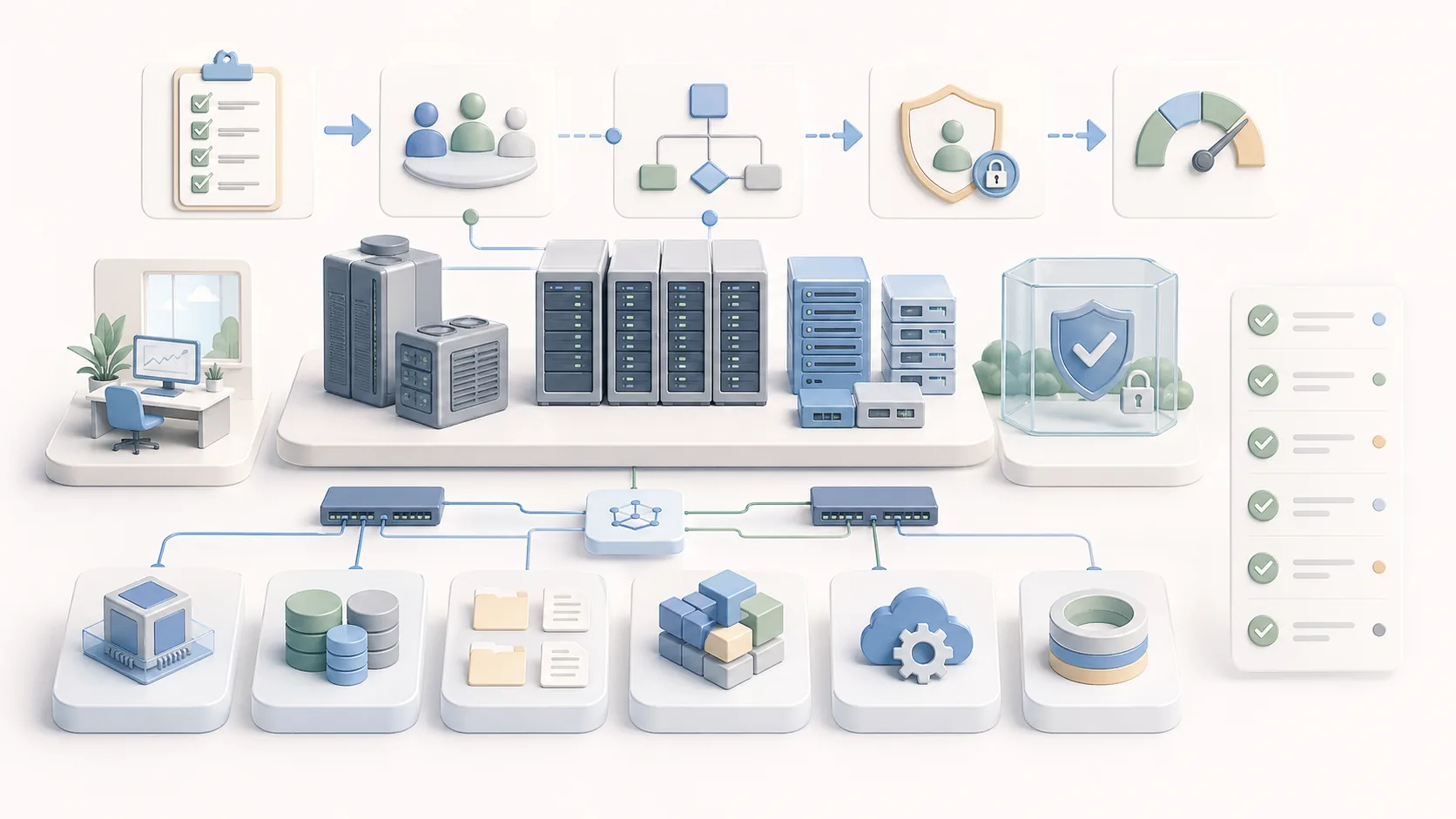
Core Advantages and Ideal Scenarios for On-Premise AI Deployment
On-premise AI refers to enterprises deploying AI models and inference services in their own or leased physical data centers, where all data processing, storage, and model inference take place within a physical boundary the enterprise controls. Compared with cloud AI services, on-premise deployment offers clear advantages in data sovereignty, regulatory compliance, latency performance, and long-term cost.
One core advantage is data sovereignty. Sensitive data such as confidential enterprise documents, customer personal data, and financial statements never has to leave the corporate network, eliminating the risk path of "data being sent to a third-party cloud for processing" and making it much simpler to document and demonstrate where data flows. Note that this only reduces one specific category of risk, not all of them: endpoint compromise, excessive internal privileges, leaked backup media, and supply-chain risk from software and model updates still each require their own dedicated controls.
On the regulatory side, Taiwan does not have a single unified data-localization law. In practice, localization pressure comes from the Personal Data Protection Act's restrictions on international transfers, the Cyber Security Management Act's security maintenance obligations for government agencies and specific non-government agencies (classified by cyber security responsibility level A through E), the Financial Supervisory Commission's rules on outsourcing and AI use by financial institutions, and medical regulations and Ministry of Health and Welfare requirements for protecting medical records and health information. On-premise deployment is generally easier to align with these requirements, but actual compliance still needs to be assessed case by case based on data type, the nature of the organization, and real data flows. The actual scope of applicability and operational requirements should be determined by the competent authority's latest announcements and your organization's (or company's) legal counsel.
The second core advantage is controllable latency. Calling an external API means every request travels a round trip over the internet, and there's no way to control the provider's queuing conditions. Latency fluctuations during peak hours are often harder to manage than the average. On-premise deployment keeps inference on the internal network, so latency is determined mainly by the enterprise's own hardware, batching, and concurrent-request settings, making it easier to set service levels.
That said, "on-premise is always faster than cloud" is still an oversimplification. Actual latency is affected by model size, quantization method, KV cache, context length, concurrent user count, and the inference framework. When comparing, use the same prompts and traffic curves, measure time to first token, output tokens per second, and P95 latency, and only then decide on a purchase.
The third advantage is predictable cost. Cloud APIs suit situations with unstable traffic that need fast access to frontier models; on-premise equipment suits long-term, stable, high-volume usage, a fixed model version, or strict data governance. You shouldn't compare only the per-token price against the GPU card price — server, networking, data-center power, cooling, software licensing, operations staffing, redundancy, and hardware depreciation all need to be folded into a one- to three-year total cost of ownership (TCO).
Scenarios well suited to on-premise AI deployment include: internal knowledge bases and document processing for financial institutions, official-document automation and decision support for government agencies, medical record analysis for healthcare institutions, quality-control knowledge management and equipment maintenance for manufacturing, and situations that require running AI offline or in environments with unstable network quality.
Hardware selection guide: GPU server specifications explained
The core of on-premise AI isn't simply buying the fastest single GPU — it's turning model weights, KV cache, concurrent request volume, memory bandwidth, GPU interconnect, power, and cooling into an operable system. FP16, FP8, and FP4 figures from different generations can't be compared directly side by side, so the table below is organized by platform tier and actual deployment role instead.
| Platform | Accelerator memory | Memory bandwidth | Suitable workloads | Deployment positioning |
|---|---|---|---|---|
| NVIDIA DGX Spark | 128 GB LPDDR5x Unified memory | 273 GB/s | Individual and small-team PoCs, agent prototyping, model evaluation, and fine-tuning tests | A desktop development platform suited to validation — not recommended for direct use as a multi-user production inference server |
| NVIDIA RTX PRO 6000 Blackwell Server Edition | 96 GB GDDR7 ECC | 1,597 GB/s | Mid-sized open-weight models, multimodal documents, vision computing, and department-level shared services | A cost-effective path spanning workstations to servers, scalable from a single card to multiple cards |
| NVIDIA H200 SXM/NVL | 141 GB HBM3e | 4.8 TB/s | Large models, long context, enterprise shared inference, and a mature Hopper software ecosystem | A stable choice for production deployment, suited to teams that prioritize supply availability, compatibility, and existing operational experience |
| NVIDIA DGX B200 | 8 張 Blackwell GPU,共 1,440 GB HBM3e | 64 TB/s aggregate across the system | Large MoE models, model fine-tuning, cross-GPU inference, and high-throughput agent services | A data-center-class system with maximum power draw of about 14.3 kW — confirm facility conditions before purchasing |
| NVIDIA DGX B300 | 8 張 B300 GPU,每張 288 GB,共 2.3 TB HBM3e | Fifth-generation NVLink interconnect at 14.4 TB/s (the manufacturer does not separately list system-level HBM bandwidth) | Ultra-large models, extremely long context, training, and large-scale inference | The Blackwell Ultra flagship system, with power draw of about 14.5 kW — requires a full assessment of rack, power, cooling, and networking |
Specifications are compiled from official NVIDIA data, updated as of August 15, 2026. The DGX Spark's 128 GB is unified memory shared between CPU and GPU, and should not be treated as equivalent to 128 GB of HBM. The B200 and B300 figures listed here refer to the 8-GPU DGX system, not single-card pricing. DGX B300 memory capacity follows the official user guide's "8 × 288 GB = 2.3 TB"; NVIDIA's product page separately lists 2.1 TB, so when requesting quotes, confirm the figure used for that batch directly with the reseller. Final procurement should still be based on the current system specifications, lead time, warranty, and power/cooling design provided by the Taiwan reseller.
When purchasing, first estimate baseline capacity from the full model weights, then add KV cache, the inference framework, batching, and any vision encoder. An MoE model activating only part of its parameters per token does not mean only the active weights need to be loaded. Long context and concurrent multi-user usage also rapidly amplify memory demand, so load testing must use real prompt length, output length, and concurrent request volume.
Beyond the GPU, plan the CPU, system memory, high-speed NVMe SSDs, network interconnect, power, and cooling together. A single-unit workstation typically prioritizes PCIe configuration and noise; a four- or eight-GPU server needs NVLink, InfiniBand, or high-speed Ethernet, rack space, per-rack power, and cooling method confirmed. For production, it's advisable to keep roughly 30% headroom and factor failover switching and maintenance-window capacity into the design.
Software Stack Architecture Design
The on-premise AI software stack has a complete architecture spanning the operating system up through the application layer. Choosing the right software substantially reduces operational complexity and improves system stability.
Operating system layer
Ubuntu Server LTS releases are the most common operating system choice for AI servers, offering broad hardware driver support and abundant community resources. Some enterprises adopt RHEL (Red Hat Enterprise Linux) or compatible distributions (such as Rocky Linux or AlmaLinux) due to security policy, which likewise support NVIDIA GPUs and mainstream AI frameworks.
For version selection, we don't recommend copying a fixed version number from any article, because operating system, GPU driver, CUDA version, and inference framework compatibility form a matrix, and each party's support timeline is not synchronized. The correct order is to first settle on the inference framework and model version, then check the CUDA and driver range it supports, and finally choose an operating system still within its support window. Once decided, lock and document the entire version set, and validate in a test environment before upgrading. GPU driver and CUDA upgrades are a common source of failures in on-premise AI.
Containerization layer (Container)
Docker is the standard containerization tool; paired with the NVIDIA Container Toolkit, it lets containers access GPU resources. Containerization helps with environment isolation and rapid deployment — different models or services can run in isolated containers, and container images are also easy to replicate across multiple servers. In production, pin the image version and hash, and establish vulnerability scanning and a software bill of materials.
Container orchestration layer (Kubernetes)
When deployment scale reaches multiple nodes or requires high availability, Kubernetes (K8s) is the de facto standard for container orchestration. The NVIDIA GPU Operator can automate GPU resource allocation management within a K8s cluster. For smaller-scale or early-stage deployments, using Docker Compose directly to manage multi-container services is a simpler option, migrating to K8s later as business needs grow.
Model serving layer
The model serving layer is responsible for receiving requests, running inference, and returning results. Ollama suits desktop development and rapid PoCs; vLLM and SGLang suit OpenAI-compatible APIs, batching, and enterprise shared services; TensorRT-LLM, NVIDIA NIM, and Dynamo suit environments that need NVIDIA-platform optimization, multi-GPU support, or large-scale serving. Actual support still depends on model architecture, quantization format, and GPU generation.
Application integration layer
An API gateway (such as Nginx or Kong) handles authentication, rate limiting, load balancing, and auditing, letting applications call on-premise AI through a unified REST API or OpenAI-compatible interface. A compatible interface lowers switching costs, but tool formats, inference parameters, and multimodal input still vary by model and may require adjustment — don't assume no code changes will ever be needed.
Comparing on-premise LLM serving solutions
Choosing the right LLM inference framework is one of the key factors in the success of an on-premise deployment. Below is a comparison of the characteristics of three mainstream options:
| Framework | Key features | Concurrency performance | Supported model formats | Best suited for |
|---|---|---|---|---|
| Ollama | Extremely simple installation, launched with a single command, supports the GGUF quantization format | Low to medium (single-request processing) | GGUF, Safetensors | Individual development, small-scale testing, rapid PoCs |
| vLLM | High concurrency via PagedAttention, continuous batching, OpenAI API compatible | High (supports tens to hundreds of concurrent requests) | Safetensors, AWQ, GPTQ | Enterprise production environments, high-concurrency inference services |
| SGLang | RadixAttention prefix caching, with constrained decoding for structured output | High, with the largest gains on shared-prefix workloads | Safetensors, AWQ, GPTQ and other mainstream formats | Multi-turn conversation, agents, and services needing reliable JSON output |
On-premise candidates for 2026 fall into three tiers. At the single-unit and workstation level, you can start by testing Gemma 4, Gemma-3-TAIDE-12B, Muse Glimmer 30B, Qwen3.8-27B, Nemotron 3.5 Lightning, gpt-oss-20b, and Ministral 3. An H200 or multiple RTX PRO 6000 units can support higher concurrent request volumes and larger quantized models. Ultra-large MoE models such as Qwen3.8-2.4T, DeepSeek V4, Kimi K3, and Nemotron 3 Ultra require a multi-GPU or multi-node data-center engineering effort for a full on-premise deployment.
TAIDE should stay in the Taiwan shortlist, since it provides a Traditional Chinese, administrative, and local-terminology baseline. Gemma 4 suits teams that need a Western supply chain, an Apache 2.0 license, and multimodal capability from edge to workstation scale. Nemotron 3.5 Lightning suits environments that prioritize the NVIDIA inference toolchain and high-throughput agent subtasks. Whether models sourced from China can be adopted should be confirmed individually against government agency regulations, industry oversight, government procurement contracts, and company supply-chain policy — the answer is not the same for general private enterprises as it is for the public sector.
Quantization reduces VRAM requirements; common formats include GGUF, AWQ, GPTQ, and NVIDIA NVFP4. Weight footprint can be roughly estimated as "total parameter count multiplied by bits per parameter, divided by 8," but actual capacity also needs to add KV cache, the inference framework, any vision encoder, and compute scratch space. For MoE models, the number of parameters activated per token mainly affects compute volume — it does not mean only weights of that same size need to be loaded.
A practical procurement process starts by fixing the model, quantization format, inference framework, target context length, concurrent request volume, and acceptable latency, then load-testing peak memory and throughput with real workloads. Finally, work backward to the GPU count, interconnect, and redundancy, keeping roughly 30% headroom for model changes and traffic growth.
Security protection and access control design
While on-premise AI systems eliminate the risk of data leaving the organization, they still require a robust internal security architecture. Below are the key security design principles:
Network isolation and segmentation
AI inference servers should be placed on an independent VLAN or network segment, isolated from the general office network. Only expose the necessary API ports externally (such as 8080 or 443), and strictly control access sources through a firewall. If the AI system needs to access an enterprise knowledge base or file system, it should go through a dedicated data access interface, avoiding directly exposing database ports.
Authentication and authorization
Enterprise AI services should integrate with existing authentication systems, such as Active Directory, LDAP, or SAML/SSO. API access should require a valid API key or JWT token, with fine-grained access control enforced by user role or department. For example, HR staff can only use the HR knowledge base, while only R&D staff can access the technical documentation repository.
Transport encryption
All API communications should enforce HTTPS (TLS 1.2 or higher) — plaintext transmission should be avoided even within the corporate internal network. For especially sensitive applications, further consider end-to-end encryption or a Zero Trust Network Access (ZTNA) architecture.
Audit logging
Complete audit logging is at the core of compliance requirements. Each AI service call should log the source IP, user account, request time, an input summary (avoid logging full sensitive content), and the response status. Logs should be stored centrally in a dedicated logging system (such as the ELK Stack) with an appropriate retention period set. There is no single retention number that applies to every organization — it should be set based on applicable regulations, the industry's regulatory requirements, data classification, and internal audit policy. A common approach is to tier readily queryable hot data separately from compressed, archived cold data; note that logs themselves may contain personal data or query content, so the retention period should be decided jointly by security and legal teams.
Operations management and continuous optimization
Operating an on-premise AI system is a long-term undertaking that requires establishing robust monitoring, update, and capacity-planning mechanisms.
Performance monitoring
GPU utilization, VRAM usage, inference latency (P50/P95/P99), and request throughput (TPS) are core monitoring metrics. We recommend building a monitoring dashboard with Prometheus + Grafana and setting alert thresholds. NVIDIA DCGM (Data Center GPU Manager) provides detailed GPU health monitoring, helping catch hardware problems early.
Model update strategy
Model version management requires a standardized process: a new model is first validated in a test environment (including performance benchmarking and business-scenario testing); only after confirming it's error-free does it move to a blue-green deployment in production, switching to the new version without interrupting service. If problems appear in the new version, you can roll back to the previous version immediately.
Capacity planning
Review usage volume, context length, cache hit rate, and P95 latency quarterly, and confirm lead times with the reseller ahead of time. Facility requirements differ substantially between workstations, H200 servers, and DGX B200/B300 systems. The DGX B200 system draws up to about 14.3 kW at maximum, and the DGX B300 about 14.5 kW — these can no longer rely on the power and cooling assumptions of a typical server rack. Procurement should be jointly signed off by the facilities, network, security, and AI platform teams beforehand.
Knowledge base maintenance
If the on-premise AI system includes a RAG knowledge base, a regular update mechanism is needed to ensure documents remain current and prevent the AI from answering based on outdated information. It should also include feedback and version tracking so users can flag incorrect responses, helping the operations team identify content that needs updating.
Further Reading
- On-Premise AI vs. Cloud AI: Complete TCO Comparative Analysis Between QubicX and Cloud Solutions
- The security advantages of on-premise AI: 5 key reasons enterprises choose local deployment to protect their data
- GPU Server vs. Cloud AI API: Complete Enterprise AI Infrastructure Cost Estimation Guide
- What Is RAG? The Principles, Architecture, and Enterprise Applications of Retrieval-Augmented Generation
FAQ
However, for domain-specific enterprise Q&A, what determines answer quality is often not the model's general capability but whether it can access the right internal documents. So once paired with RAG that retrieves the enterprise's latest policies and documents, an on-premise system's practical performance on "answering questions about your company" has a real chance of matching a general-purpose cloud model that lacks your data. But this isn't a guaranteed outcome — it still depends on retrieval quality, document versioning, and chunking strategy, and should be verified with your own test set.
Staffing needs can't be summed up with one fixed number — they depend on four variables: the availability level you've committed to (whether on-call duty and failover switching are needed), security requirements (whether periodic vulnerability scanning, patching, and audit reports are required), model update frequency, and whether knowledge base content governance sits with IT or the business unit. If availability requirements are modest and the business unit maintains the knowledge base itself, part-time IT staffing is usually enough; if near-round-the-clock service levels or strict security audit obligations are required, dedicated staffing and a backup-personnel mechanism should be planned. It's advisable to spell out these four items clearly before deployment, and estimate staffing from there, rather than assuming a headcount first.
References
- NVIDIA.H200 Tensor Core GPU。nvidia.com
- NVIDIA.RTX PRO 6000 Blackwell Server Edition。nvidia.com
- NVIDIA.DGX Spark。nvidia.com
- NVIDIA.DGX B200。nvidia.com
- NVIDIA.DGX B300 User Guide。docs.nvidia.com
- Kwon, W. et al. (2023). "Efficient Memory Management for Large Language Model Serving with PagedAttention." SOSP 2023. DOI: 10.1145/3600006.3613165
- Regulations on Classification of Cyber Security Responsibility Levels (資通安全責任等級分級辦法), current text, levels A through E; administered by the Ministry of Digital Affairs. Laws & Regulations Database: law.moj.gov.tw;資安法規彙整:moda.gov.tw
- Touvron, H. et al. (2023). "Llama 2: Open Foundation and Fine-Tuned Chat Models." arXiv:2307.09288. arXiv
Ready to Start Planning Your On-Premise AI Infrastructure?
Contact LargitData's solution consultants — we'll provide tailored on-premise AI deployment planning recommendations based on your company's size, data sensitivity, and use cases.
Contact Us