How Much Does Sentiment Analysis Cost? 2026 Enterprise Procurement Complete Pricing Guide
Sentiment analysis platform expenditures vary significantly by feature depth, monitoring scale, and deployment architecture without a universal flat rate. This guide outlines essential pricing structures, key cost drivers, build-vs-buy TCO components, and ROI estimation methods to help you clarify requirements and budget rationale before soliciting vendor proposals. All currency figures mentioned are illustrative simulations grounded in explicit assumptions and do not represent formal vendor quotes; request official quotes tailored to your specifications.
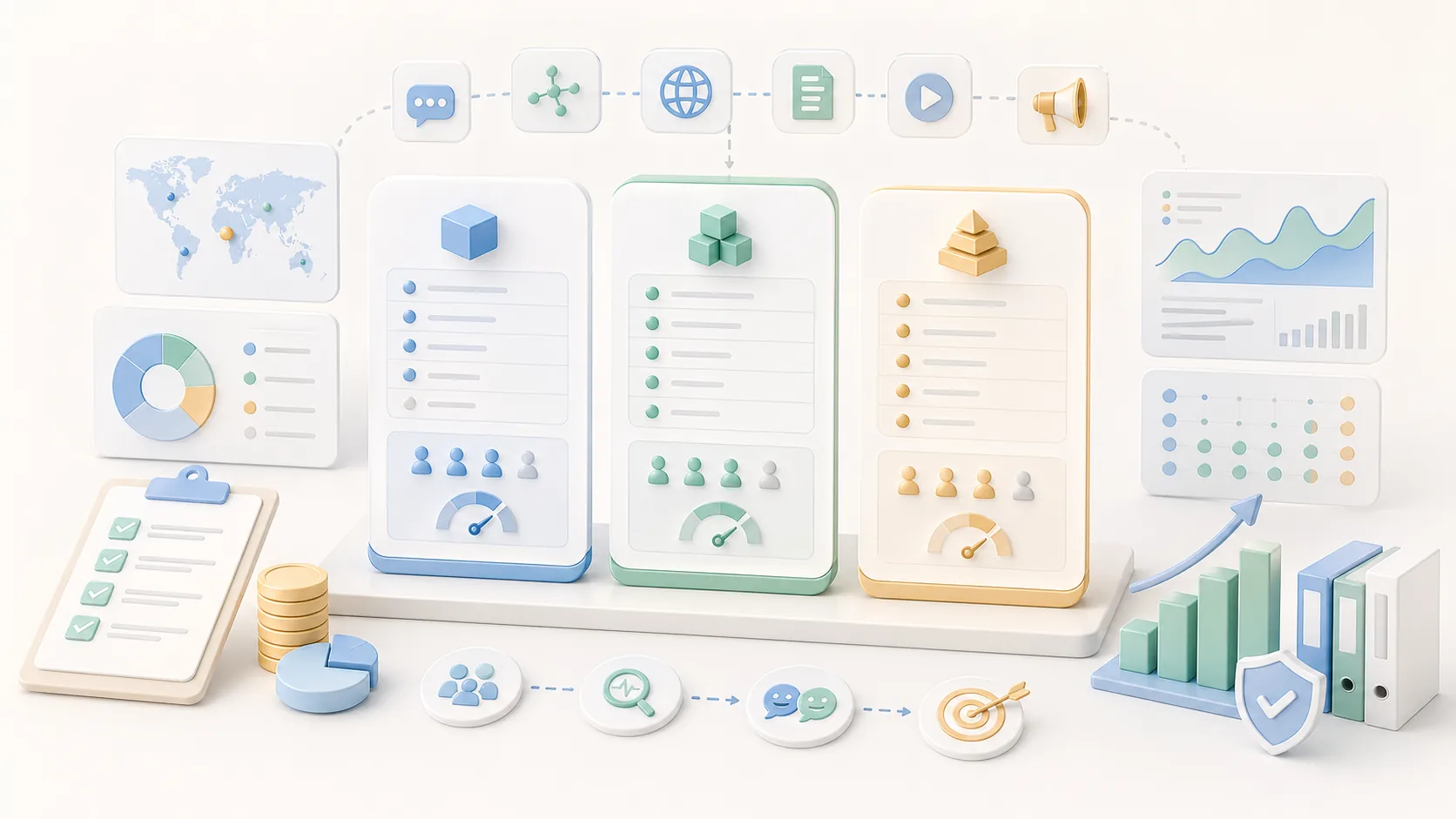
Cost Components of Sentiment Analysis Platforms
Before evaluating sentiment analysis expenditures, understand how platform pricing is structured. Sentiment analysis pricing typically encompasses several core components that directly shape the final quotation.
First is data collection and licensing costs. Sentiment platforms continuously ingest and index data across news media, social platforms (Facebook, Instagram, YouTube, X/Twitter, LINE), forums (PTT, Dcard, Mobile01), and e-commerce reviews. Licensing costs vary per source; integrating broader channels scales costs accordingly, with premium news archives requiring additional licensing.
Second is AI analytical compute costs. Capabilities like sentiment classification (positive/negative/neutral), topic clustering, KOL identification, and trend forecasting rely on extensive NLP and machine learning compute resources, representing a major component of platform pricing.
Third is storage and query compute costs. Retaining longer historical archives scales storage overhead. Many platforms tier pricing by historical depth: entry plans may retain 3 months of data, while enterprise tiers provide 1 to 3 years or longer historical retrieval.
Fourth is platform feature licensing. Advanced features like automated scheduled reports, API access, competitive intelligence benchmarks, crisis push alerts, and customizable dashboards typically require upgrading to higher-tier subscriptions.
Fifth is user seat licensing. Certain platforms price per named user account, scaling with seat count. When procuring, verify base seat allocations included in standard tiers and per-seat fees for incremental users.
Comparison of Primary Pricing Models
Sentiment analysis solutions typically divide into tiers tailored to specific use cases. The table below represents an illustrative simulation explaining how tier differentials arise, not a prevailing market price or official vendor quote.
The figures in this table rely on the following assumptions, where modifying any factor will shift estimates significantly: (1) Data Sources: Starter tier covers major news media and one social platform; Professional tier covers major social platforms and local Taiwan forums; Enterprise tier includes custom scrapers or add-on sources. (2) Query and Data Volume: Assumes keyword set counts as listed in the 'Key Features' column with average daily hit volumes typical of mid-sized brands; high-volume brands or crisis spikes may require separate calculation. (3) Historical Retention: Retention windows as listed; extending retention increases storage and retrieval compute costs. (4) Staffing: Assumes standard vendor customer support, excluding dedicated consulting or custom report writing labor. (5) Hardware and Compute: Assumes vendor shared cloud multi-tenancy; on-premise or dedicated hosting calculated separately. (6) Licensing: Assumes exclusion of premium paywalled media databases or third-party API licensing fees.
| Plan Tier | Illustrative Monthly Fee Estimate (NTD, Not an Official Quote) | Target Users | Key Features |
|---|---|---|---|
| Starter Plan | NT$5,000–15,000 | SMEs, startups, early-stage brand monitoring | 3-5 keyword sets, major media monitoring, daily reports, 3 months historical data |
| Professional Plan | NT$15,000–50,000 | Mid-to-large enterprises, PR agencies, public company brand teams | 10-30 keyword sets, omni-media monitoring including social, advanced sentiment analysis, competitor benchmarks, API access, 1 year historical data |
| Enterprise Subscription | NT$50,000+ | Large corporations, financial institutions, enterprise brand groups | Unlimited keywords, custom data sources, dedicated consultant support, crisis alerts, 3+ years historical data, SLA guarantees |
| Government Procurement Plan | Custom Quote per RFP Specs (Annual Procurement) | Central ministries, municipal governments, state-owned enterprises | Customized to RFP specifications, Joint Supply Contract support, tailored reports, multi-agency sharing, cybersecurity compliance |
Beyond monthly SaaS subscriptions, vendors offer annual prepayment discounts, perpetual/buyout licensing (for on-premise enterprise deployments), and flexible pay-as-you-go billing. Discount terms and margins vary by vendor and negotiation; confirm these during contract discussions alongside renewal pricing mechanisms. If first-year introductory discounts expire upon renewal, 3-year TCO projections shift drastically.
In Taiwan, public agency procurement must adhere to the Government Procurement Act and regulatory directives. Common pathways include Joint Supply Contracts, open tendering, and threshold-based simplified procurement; statutory conditions, monetary thresholds, and procedural workflows evolve with official announcements and should not rely on unverified figures. Joint Supply Contracts offer administrative ease with fixed specifications; agencies with bespoke requirements typically execute customized open tenders where total expenditures reflect specification scope.
Procurement procedures and current regulations can be viewed on the Government e-Procurement System:Government e-Procurement System. Regulatory scope and operational requirements are subject to latest official announcements and determinations by internal ethics, accounting, and procurement units.
Key Factors Influencing Cost
Understanding the core cost drivers of sentiment analysis empowers you during contract negotiations, preventing unnecessary expenditures beyond actual requirements.
Monitored Keyword Volume
Virtually all sentiment analysis platforms use keyword sets as their primary pricing unit. A keyword set typically comprises a core brand or topic query with associated contextual modifiers and negative filters. Standard brand monitoring requires 5 to 10 sets, while enterprises tracking multiple brands, competitors, and industry topics often require 30 or more. Inventory all required topics prior to procurement to size keyword allocations accurately.
Data Source Breadth
Broader data source coverage scales costs. Basic monitoring generally includes major news outlets and Facebook; full omni-channel monitoring spans Instagram, YouTube, X (formerly Twitter), official LINE accounts, PTT, and Dcard. Specialized niche forums, LINE groups, overseas media, or specific e-commerce review sites may require add-on subscriptions.
Historical Data Archive Depth
During crisis events, organizations must retrospectively analyze historical data trends. Standard plans typically retain 3 to 6 months of data; extending historical querying to 1 year or more increases pricing. For enterprises conducting multi-year trend analytics or annual reporting, we recommend plans retaining at least 1 year of historical archives.
API Access and System Integration
Many enterprises require integrating sentiment intelligence into internal CRMs, BI suites, ERPs, or proprietary dashboards. API access is typically an add-on priced by call volume or throughput. Automated integration connectors or bespoke webhooks may also incur engineering integration fees.
Report Automation and Export
Automated report scheduling, multi-format exports (PDF, Excel, PowerPoint), white-label reports (removing vendor branding), and bespoke templates vary widely across tiers. For PR agencies or corporate teams reporting regularly to leadership and clients, reporting versatility can matter more than raw data volume.
Self-Built System vs. SaaS Procurement Cost Analysis
Large corporations and public agencies often consider building in-house sentiment analysis systems for full data sovereignty and customization. True self-hosted costs are frequently underestimated, yet actual expenditure is entirely specification-dependent—spec-free ballpark figures are meaningless. Rather than relying on generic estimates, itemize all Total Cost of Ownership (TCO) components and populate them with organization-specific parameters. This represents the most defensible approach when presenting to leadership or procurement boards.
| TCO Cost Item | Self-Built Responsibilities (Key Questions for Cost Estimation) | Equivalent Scenario in SaaS Procurement |
|---|---|---|
| Initial Buildout | Scraping infrastructure, data cleaning/deduplication pipelines, NLP/sentiment models, frontend dashboards, access control, and audit logging. Estimation: break down into man-months multiplied by internal or outsourced burdened billing rates. | Usually a one-time onboarding fee or waived; verify inclusion of keyword provisioning, channel setup, and user training. |
| Human Resources | Required engineering roles (data engineering, ML, backend, SRE/Ops), FTE allocation ratios, and talent retention. Factor in opportunity costs for diverted internal talent. | Typically requires fractional IT/analyst liaison time; internal personnel must still handle keyword maintenance and report interpretation. |
| Hardware and Infrastructure | Servers or cloud compute, GPUs (if hosting self-managed inference), database and object storage, network bandwidth for crawlers, and redundancy/backup. Capacity sizing should be provisioned for peak rather than average throughput. | Typically included in SaaS subscription tiers; calculated separately for on-premise or dedicated instances. |
| Data Licensing | Licensing terms across media publishers and social platforms, commercial re-use/redistribution permissions, and negotiation costs and turnaround. This is the most frequently overlooked and legally fraught component of self-hosted builds. | Platforms typically secure upstream licensing for bundled sources; verify whether authorization scopes cover your organization's specific use cases. |
| Model Operations | Periodic retraining or fine-tuning, labeled dataset curation and QA, evaluation benchmark maintenance, and model drift/degradation monitoring. | Handled by the vendor; confirm update cadence and support for custom dictionaries and domain fine-tuning. |
| Continuous Maintenance | Crawler fixes due to upstream platform DOM/API changes, new source onboarding, troubleshooting, and on-call rotations. High change frequency makes this a heavy, unpredictable recurring expense. | Absorbed by the vendor; verify contractual obligations regarding source disruption notifications and remediations. |
| Compliance and Cybersecurity | PII inventory, access control, audit logging, vulnerability scanning, penetration testing, and agency-specific cybersecurity tier requirements. | Review vendor compliance certifications and contract terms to clearly delineate responsibility boundaries. |
| Exit Costs | Data archiving and migration protocols upon decommissioning; knowledge continuity across staffing changes. | Verify contract clauses for data migration and export to prevent vendor lock-in. |
Inputting empirical figures across these dimensions typically yields a universal takeaway: self-built costs center not on upfront engineering, but on continuous maintenance and data licensing—the two recurring categories hardest to budget in advance. In-house development fits organizations with deep engineering teams and strict data sovereignty or customization mandates; if the primary goal is fast, reliable monitoring, off-the-shelf procurement is substantially more efficient in time and manpower. Regardless of direction, evaluate TCO over a 3-year horizon rather than 1 year to reveal true cost divergence.
How to Evaluate Return on Investment (ROI)
While sentiment analysis ROI cannot be captured by a single formula, the following frameworks help justify investments to procurement committees and executive leadership.
Crisis Loss Prevention Value
Brand crisis damages lack a standardized industry average: they depend heavily on industry vertical, incident severity, corporate scale, and tangible damages, requiring bespoke modeling. A structured approach breaks down cost components using organizational baselines: (1) Response Labor: overtime and opportunity costs across PR, legal, customer support, and sales; (2) Marketing Freezes: paused ad campaigns and unrecoverable production outlays; (3) Channel Fallout: retail delistings, returns, delayed purchase orders, and distributor penalties; (4) Compliance and Professional Services: legal counsel, crisis PR retainers, lab testing, and audit fees; (5) Reputation Recovery: post-crisis marketing spend required to rebuild brand trust.
Summing these five components establishes an estimated loss range for a moderate crisis event. Multiplying this figure by estimated annual probability and the loss reduction percentage achieved through early warning yields a defensible figure for budget discussions. The objective is not pinpoint precision, but rather a transparent, testable set of assumptions; presenting arbitrary industry averages invites skepticism during procurement reviews.
PR and Communications Efficiency Gains
Traditional PR monitoring relies on manual clipping and manual browsing; automated monitoring redirects data collection hours into strategic analysis. Quantifying this is straightforward using internal baseline metrics: measure daily hours currently dedicated to monitoring and compilation, re-measure post-deployment to determine hours saved, multiply by fully burdened labor rates (salary, health/labor insurance, bonuses, and overhead per labor hour) to derive annual savings, and subtract annual subscription fees and onboarding costs to calculate net ROI.
Two caveats: 1. If saved hours are not channeled into productive output, benefits remain purely theoretical; specify in business cases how reclaimed time will be utilized. 2. Onboarding periods typically increase workloads initially (keyword calibration, false-positive filtering); incorporate early-stage learning curves into financial models to avoid unrealistic Q1 expectations. (Illustrative methodology only; does not constitute guaranteed performance).
Market Intelligence and Competitive Insights
Sentiment data is a vital input for market intelligence. By analyzing competitor sentiment trajectories, consumer reviews, and customer complaints, enterprises uncover product differentiation opportunities. While challenging to quantify precisely, this intelligence delivers substantive value to marketing strategy.
ROI Calculation Formula
Simplified ROI Formula: (Expected Crisis Loss × Early Warning Success Rate) + (Annual Labor Cost Savings) + (Revenue Growth from Market Intelligence) - (Annual Subscription Costs). We advise conservative crisis prevention assumptions in internal proposals to present credible ROI projections.
10 Essential Questions to Ask Before Procurement
When evaluating sentiment analysis vendors, asking these 10 questions ensures solutions meet organizational needs and prevents unforeseen hidden expenses.
- 1. What data sources are monitored? Does coverage include PTT, Dcard, public LINE channels, and YouTube comments?
- 2. What are the keyword set limits, and what are the billing terms for overages?
- 3. What is the historical data retention window, and what are the fees for extending historical archives?
- 4. What is the sentiment analysis accuracy rate, particularly for Chinese (especially Traditional Chinese) nuances?
- 5. What is the data refresh frequency? How often are news articles updated, and what is the latency for social posts?
- 6. Is API access supported? Are there call quotas, and what are the overage rates?
- 7. Do reporting tools support customization? Can raw datasets be exported (CSV/Excel)?
- 8. How many user seats are included, and what is the cost for additional licenses?
- 9. Is a free trial or Proof of Concept (PoC) offered?
- 10. What customer service and technical support channels are available, and is tailored onboarding training included?
Finally, request quotations from at least 2 to 3 vendors before procurement, standardizing monitoring scope across proposals for objective comparability. Additionally, ensure contracts include data migration clauses to prevent vendor lock-in risks.