Recommended sentiment analysis tools 2026: a complete comparison and selection guide to the top 10 tools
A dizzying array of sentiment analysis tools populates the market, spanning free social listening utilities to enterprise-grade omni-channel platforms, with massive disparities in features and pricing. This guide conducts an in-depth 2026 comparison across Taiwan localization coverage, Chinese NLP accuracy, real-time speed, API integration, and reporting capabilities, establishing a comprehensive evaluation framework to help enterprises secure optimal solutions within budget.
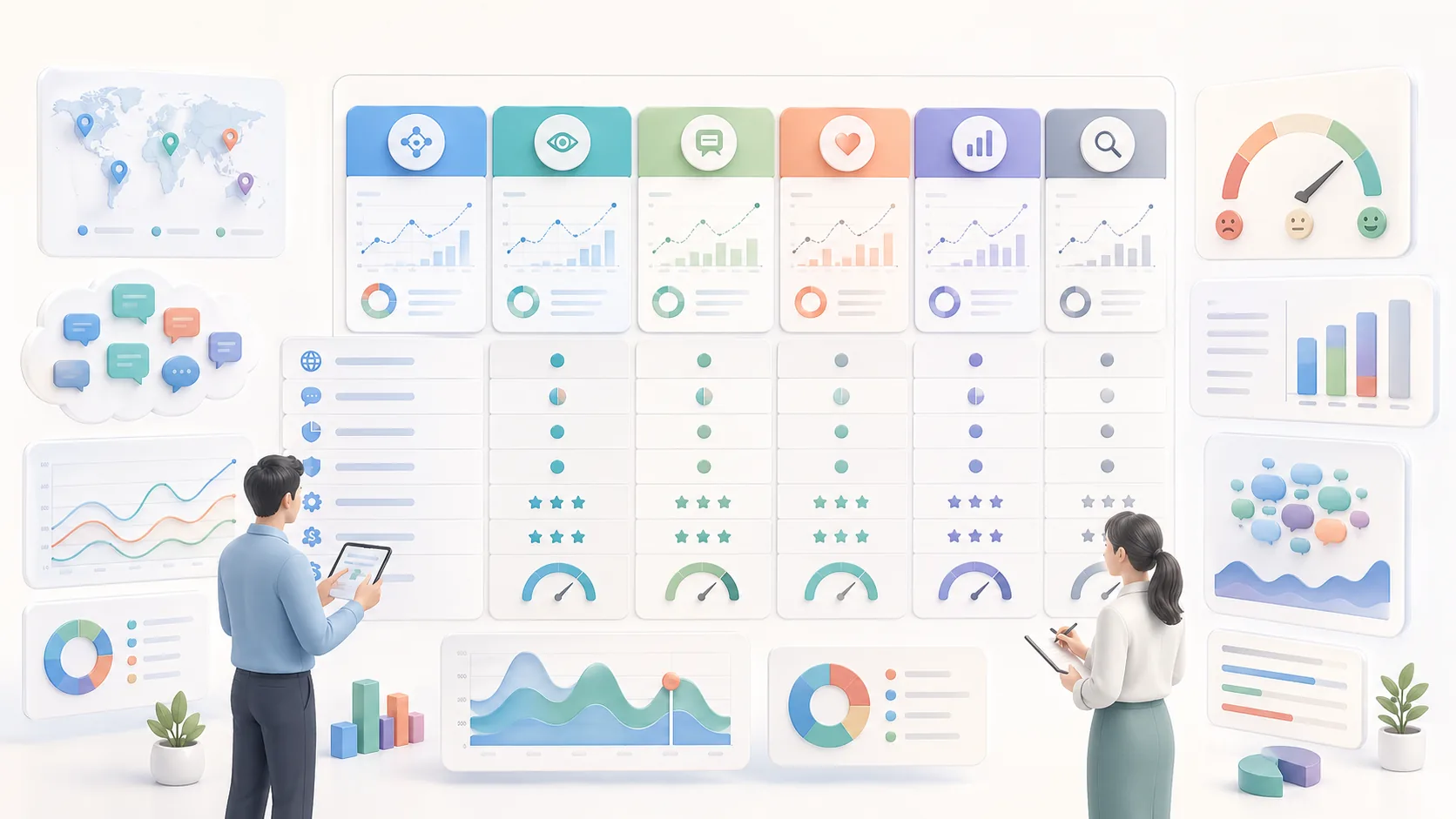
5 Key Criteria for Sentiment Tool Selection
Before evaluating competing platforms, establish unambiguous organizational selection criteria. Ambiguous criteria often result in discovering post-purchase that tools fail key operational requirements. Drawing on practical enterprise experience in Taiwan, the following five dimensions represent the most decisive evaluation criteria:
First is local Taiwan platform coverage. Taiwan's public discourse ecosystem differs significantly from global markets; domestic forums like PTT, Dcard, Mobile01, and Bahamut carry substantial authentic public opinion. If a tool fails to comprehensively monitor these platforms, analytical insights suffer from severe blind spots. While many international tools are feature-rich, their coverage of Taiwan-native communities is minimal, severely limiting operational utility.
Second is Traditional Chinese NLP accuracy. Chinese carries high semantic ambiguity, layered with Taiwan's distinctive internet slang, sarcasm, and localized idioms, demanding advanced NLP engineering. Models trained primarily on Simplified Chinese corpora exhibit systematic biases when processing Traditional Chinese discourse, frequently misclassifying sarcasm, double negatives, and colloquial slang.
Accuracy should never be accepted solely from vendor marketing claims; validate it internally. A practical method extracts 200 to 500 authentic industry posts and comments, double-annotated by two internal colleagues to establish consensus gold standards (discrepancies form valuable hard test cases), then runs the dataset across candidate platforms. Evaluate overall precision, alongside negative sentiment recall (overlooking negative backlash carries the highest business cost) and sarcasm classification.
Third is data refresh timeliness. In the social media era, negative sentiment can erupt virally within 30 minutes. Ingestion frequencies (daily, hourly, or near-real-time) directly dictate whether an organization can react during the golden window of crisis mitigation. Automated real-time push alerts form a critical selection criterion.
Fourth is API and system integration capabilities. Sophisticated enterprises rarely operate sentiment platforms in silos, integrating data streams into CRMs, BI suites, or proprietary data lakes. Comprehensive RESTful API documentation, webhook support, and pre-built connectors for mainstream BI tools (Tableau, Power BI) are indispensable requirements for large enterprises.
Fifth is reporting and data visualization capabilities. The core value of sentiment analysis lies in empowering decision-makers who lack time to parse raw data logs. Automated report generation, executive dashboards, sentiment trajectory graphs, and volume leaderboards determine whether a tool integrates seamlessly into day-to-day business operations.
Taiwan Localization: Why Global Tools Often Fall Short
Influenced by global brand prominence, many enterprises initially evaluate international vendors like Brandwatch, Meltwater, and Sprinklr. While these tools excel in Western markets, they encounter fundamental hurdles in the Taiwan market.
First is language model adaptation. Traditional Chinese in Taiwan employs a unique lexicon—terms like 'keyboard Conan', 'cyber army', and 'lazy pack' are absent from international sentiment dictionaries. More critically, some international tools process Traditional Chinese text using Simplified Chinese models, introducing systematic classification errors.
Second is local data source licensing. Taiwan's mainstream forums like PTT and Dcard maintain strict technical controls on scraping; international tools rarely hold authorized data partnerships, leaving these critical arenas absent from analyses. In contrast, domestic vendors establish formal licensing and compliance partnerships with local platforms, ensuring completeness and legality.
Furthermore, Taiwan's media ecosystem is nuanced: national news outlets, regional publishers, content syndicators, and polarized digital publications coexist and churn rapidly. If media indexing is deficient, critical public discourse goes unmonitored. When assessing coverage, look beyond raw source counts; mandate actual publisher inventories and cross-verify with 3 to 5 recent real-world news articles. If those articles do not index, abstract counts are meaningless. Also clarify maintenance mechanisms: is the source directory updated systematically or updated reactively?
Feature Comparison of Major Sentiment Analysis Tools
The table below compares major categories of sentiment analysis tools across six core dimensions to help organizations rapidly assess functional differences:
| Assessment Dimensions | Taiwan Domestic Enterprise Platform (e.g., InfoMiner) | International Enterprise Platforms (e.g., Brandwatch, Meltwater) | Lightweight SaaS Tools | Free / Open-Source Tools |
|---|---|---|---|---|
| Taiwan Local Platform Coverage (PTT, Dcard, etc.) | Comprehensive Coverage | Limited or No Coverage | Partial Coverage | Requires Self-Developed Crawlers |
| Traditional Chinese NLP Adaptation Level | Deeply optimized for Traditional Chinese and Taiwan idioms | Primarily Simplified Chinese or multilingual models; significant gaps in local terminology | Basic Chinese Support | Model-dependent with wide variance |
| Data Refresh Frequency | Near-Real-Time (depends on source and plan; subject to contract terms) | Near-Real-Time (primarily international content) | Daily to Hourly | Manual Trigger |
| API Integration Capabilities | Full RESTful API + Webhook | Comprehensive API Documentation | Basic API | Requires In-House Development |
| Reporting and Visualization | Custom Dashboards + Automated Reports | Rich Visualization Templates | Default Dashboards | None or Minimalist |
| Suitable Organization Size | Mid-to-Large Enterprises, Government Agencies | Multinational Corporations | SMEs | Individual / Research Use |
| Pricing Tier | High (priced by keyword sets, source scope, and modules) | High (foreign-currency billing with exchange rate risk) | Medium-Low (monthly billing common) | Free license, with engineering and maintenance costs |
This table provides qualitative category comparisons rather than individual product specifications or quotations. Sourcing coverage, refresh frequency, and pricing structures vary substantially across vendors and evolve by contract tier; refer to formal vendor proposals and terms of service, and incorporate source inventories and latency SLAs as auditable contract acceptance criteria.
Free vs. Paid Tools: Where the True Disparities Lie
When evaluating sentiment analysis tools, many enterprises initially test free utilities like Google Alerts, Mention (free tier), or open-source NLP packages like VADER and TextBlob. While providing baseline monitoring under constrained resources, these tools quickly hit operational ceilings in enterprise environments.
Core limitations of free tools include: (1) Incomplete coverage: typically monitoring only select open web pages while missing critical forums and gated communities; (2) Shallow depth: lacking aspect-based sentiment, fine-grained emotions, and KOL scoring; (3) Absence of real-time push alerts: unable to notify stakeholders immediately when crises erupt; (4) Lack of structured reporting: raw outputs cannot be directly presented to executive management.
Beyond resolving these shortcomings, paid enterprise platforms deliver SLA availability guarantees, dedicated Customer Success managers, continuous model retraining and lexicon optimization, and enterprise-grade data isolation with role-based access control. For enterprises where brand reputation carries high commercial sensitivity, these operational guarantees often outweigh standalone software features.
Significantly, 'cheap' sentiment tools often prove more expensive over time. Evaluate this empirically: provide tool outputs to analysts and track how many hours they spend manually verifying and correcting misclassifications daily. If accuracy is insufficient for direct deployment, ongoing review costs accumulate; combined with delayed crisis mitigation from false negatives, total expenditures quickly surpass license savings. When comparing pricing, calculate 'Annual Software Fee + Estimated Manual Review Labor' rather than evaluating shelf pricing in isolation.
Enterprise Selection Recommendations: Optimal Strategies Across Different Scales
Selection strategies should align with corporate scale, industry dynamics, and internal resource allocation; below are recommendations across three typical enterprise profiles:
Large Enterprises and Conglomerates (500+ employees): We recommend enterprise-tier platforms with comprehensive API capabilities to integrate deeply into existing CRM, ERP, and BI stacks. Prioritize vendors offering on-premise or dedicated private cloud deployment options to satisfy data privacy and cybersecurity compliance mandates. During technical evaluations, mandate vendor participation in Proof of Concept (PoC) testing using authentic Traditional Chinese domain datasets to validate NLP accuracy rather than relying on vendor benchmarks alone.
Mid-Sized Enterprises (50–500 employees): Balance feature completeness with cost efficiency. Opt for SaaS solutions from domestic Taiwan providers to secure comprehensive local platform coverage while avoiding high foreign-currency licensing fees associated with international suites. Begin with core brand monitoring, scaling modularly into competitor benchmarking and KOL tracking as business needs evolve.
SMEs and Startups (under 50 employees): In budget-constrained environments, choose lightweight SaaS tools with monthly flexible billing and scalable tiers. Focus strictly on essential use cases (such as brand keyword monitoring and daily briefing summaries), avoiding payment for unutilized features. Evaluate UI usability to ensure non-technical marketing or PR staff can independently navigate the tool, keeping onboarding friction minimal.
Regardless of scale, conduct a free trial of at least two weeks before committing, evaluating core capabilities against authentic business scenarios. In particular, test: Can the tool accurately detect and classify sentiment in past crisis events? Does it correctly interpret industry-specific jargon and sentiment polarity? Empirical validation on your own data provides far more diagnostic value than spec sheets.
How to Evaluate the ROI of Sentiment Analysis Tools
The ultimate objective of procuring sentiment analysis tools is generating commercial value; establish a transparent ROI evaluation framework during the selection phase. Quantify value across three core pillars:
Quantifying Crisis Prevention Value: PR crisis losses vary drastically by industry, incident nature, and brand scale; avoid citing arbitrary external averages in internal proposals. A defensible approach models historical internal incidents: inventory 3 to 5 negative events from the past two years, recording the elapsed hours between the first post's appearance and internal awareness, along with incurred labor and professional fees. Measuring whether post-deployment detection latency shrinks isolates the true operational variable improved by the tool—an auditable metric for leadership. InfoMiner supports this via 24/7 automated real-time alert mechanisms.
Efficiency Gains and Cost Reductions: Traditionally, enterprises assign dedicated personnel to manually search and curate online discussions daily—a repetitive, time-intensive process. For LargitData clients, adopting InfoMiner reduced report generation times from 4 hours to 30 minutes, delivering an 80% operational efficiency boost. To replicate this, establish an operational baseline: log daily headcount and hours spent on manual collection and compiling, identifying how much time involves rote copy-pasting. With a rigorous baseline, before-and-after deltas become meaningful, confirming whether reclaimed hours genuinely transition into strategic analysis rather than incidental chores.
Market Insight Value: Leveraging sentiment analysis to uncover market trends, shifting consumer needs, and competitor strategies empowers product development, marketing campaigns, and pricing strategies. While challenging to quantify—and easily overstated in business cases—attributing revenue growth entirely to sentiment tooling is fragile due to price, distribution, competitor, and seasonal variables. A credible approach tracks intermediate operational proxies: turnaround time to triage negative themes to responsible units, campaign creative iterations prompted by public feedback, and refresh cadences for customer support FAQ repositories. These metrics maintain clear causal links to tooling without inviting retrospective scrutiny.
Further Reading
FAQ
To obtain comparable quotations, circulate a unified RFP specification across vendors and request itemized pricing breakdowns. Inquire specifically about three common ancillary charges: overage billing terms, historical archive extension fees, and API call rate limits. Review contract durations and renewal price adjustment clauses concurrently.
Practical recommendations: prioritize official public APIs adhering to rate limits, avoid harvesting extraneous personal data, maintain internal lineage records documenting acquisition methods for auditing, and require vendors to disclose data sourcing methods and licensing statuses during procurement. Regulatory compliance remains subject to latest official announcements and corporate legal counsel determinations.
Looking for the Optimal Sentiment Analysis Solution for Taiwan Enterprises?
Contact LargitData's sentiment analysis consultants. We will provide tailored architectural recommendations and free trial evaluations aligned with your industry vertical, monitoring scope, and budget.
Contact Us