Complete Guide to Enterprise AI Knowledge Management Systems: RAG Technology That Activates Dormant Knowledge
An Enterprise AI Knowledge Management System integrates artificial intelligence across the entire enterprise knowledge asset lifecycle, automating the collection, organization, indexing, and extraction of unstructured internal knowledge so employees and systems can retrieve needed data on demand. According to ResearchAndMarkets' RAG market trend report (2025–2035), the global RAG market stood at approximately US$1.96 billion in 2025 and is projected to expand at a CAGR of 49.1% to exceed US$11 billion by 2030. This guide provides decision-makers with a comprehensive roadmap covering technical principles, ROI benefits, selection strategies, and future trends.
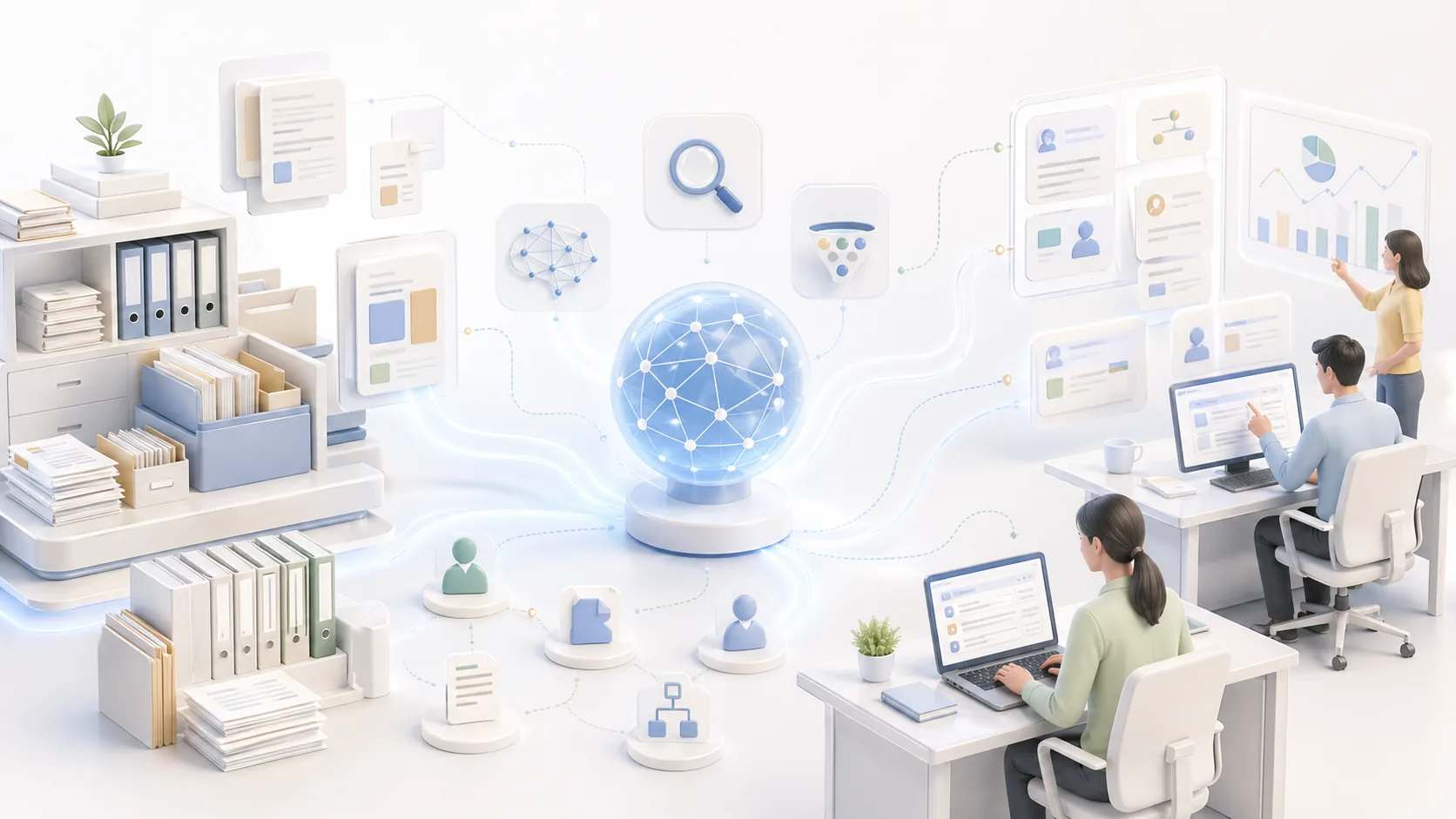
What Is an Enterprise AI Knowledge Management System? Core Concepts and Definitions
An enterprise AI knowledge management system is a platform solution that uses AI technologies—including natural language processing (NLP), vector search, and large language models—to automatically transform unstructured corporate knowledge (documents, reports, emails, meeting notes, manuals) into an intelligent knowledge base available for real-time queries. Unlike traditional document management systems (DMS), an AI knowledge management system can "understand" the semantic meaning of document content rather than relying solely on keyword matching, enabling it to answer natural-language questions and deliver precise, context-aware responses.
The core challenge facing traditional knowledge management is the problem of knowledge silos. According to landmark research from the McKinsey Global Institute, knowledge workers spend roughly 19% of their working hours searching for and gathering information (a widely cited metric since 2012), costing enterprises tens of billions of dollars annually in lost productivity from hindered sharing. AI knowledge management systems break down departmental barriers via unified semantic search interfaces, ensuring the right knowledge reaches the right users at the right time and translating directly into measurable business value.
Modern enterprise AI knowledge management systems center on RAG (Retrieval-Augmented Generation) as their core architecture. According to ResearchAndMarkets.com, the global RAG market reached US$1.96 billion in 2025 and is projected to surpass US$40.3 billion by 2035 at a CAGR of 35.3%. This rapid expansion reflects urgent enterprise demand for uniting precise knowledge retrieval with natural language generation, marking a new AI-driven era in enterprise knowledge governance.
How Does RAG Technology Work? The Three-Stage Core Mechanism of Enterprise AI Knowledge Bases
RAG (Retrieval-Augmented Generation) is an AI architecture uniting information retrieval systems with generative large language models. By retrieving relevant document passages from enterprise knowledge repositories before generating answers, it fundamentally addresses LLM hallucinations and knowledge cutoff dates, enabling systems to deliver trustworthy, auditable answers grounded in the latest internal data. According to the seminal RAG paper (Lewis et al., 2020, NeurIPS), the RAG framework boosted open-domain Q&A accuracy by 18–28 percentage points over pure LLM approaches.
Stage 1: Knowledge Indexing
The system first parses and chunks the organization's various document types (PDF, Word, Excel, email, web pages, etc.), converting each text passage into a high-dimensional vector using an embedding model and storing it in a vector database. This process creates a "semantic map" of enterprise knowledge, enabling the system to search based on semantic similarity rather than keyword matching alone. High-quality chunking strategies—such as overlapping chunks and semantic-boundary chunking—are critical factors that determine the quality of knowledge base searches.
Stage 2: Semantic Retrieval
When a user submits a query, the system converts it into an embedding vector and performs similarity searches in a vector database (typically cosine similarity or dot product) to identify the most semantically relevant knowledge fragments. Advanced enterprise RAG systems combine hybrid search strategies—leveraging dense vector search alongside traditional keyword search (BM25)—and refine results using reranker models. Research demonstrates that hybrid search strategies enhance Precision@5 by an average of 12–19% compared to pure vector search alone.
Stage 3: Augmented Generation
The system combines the retrieved relevant knowledge passages with the original question into a prompt, which is fed into the large language model for reasoning and generation. The language model generates precise, evidence-based answers grounded in the provided knowledge context and annotates the information sources so users can trace and verify the reliability of each response. This design ensures explainability and auditability of AI system outputs—an indispensable compliance value for strictly regulated industries such as finance, law, and healthcare.
Four Core Benefits of Implementing an Enterprise AI Knowledge Management System
The core benefit of enterprise AI knowledge management systems is drastically reducing information search overhead while converting tacit knowledge into measurable organizational competitive advantage—particularly vital for sectors with high turnover or difficult knowledge handover. According to Writer's 2025 enterprise AI adoption survey, organizations with a formalized AI strategy achieved an 80% adoption success rate versus 37% for those without; ISG's '2025 State of Enterprise AI Adoption Report' noted that 31% of use cases reached full production, doubling the prior year. Knowledge management has emerged as the fastest-growing functional domain for AI after IT and marketing.
| Benefit Dimension | Specific Metrics | Typical Industries |
|---|---|---|
| Information Access Speed | Search time reduced by 60–80% | Customer Service, Legal, R&D |
| New Employee Training Cycle | Training time reduced by 40–60% | Manufacturing, Finance, Healthcare |
| Knowledge Consistency | Document version errors reduced by 90%+ | Compliance-Intensive Industries |
| Compliance Audit Cost | Audit preparation time reduced by 50% | Finance, Pharmaceuticals, Government |
1. Dramatically Reduce Information Access Time
AI knowledge management systems accurately pinpoint information across hundreds of thousands of documents in seconds, saving 60–80% of search time compared to traditional manual searching. For knowledge-intensive functions like customer support, legal, and R&D, personnel obtain instant, exact SOP guidelines, regulatory interpretations, or technical specs, dramatically elevating productivity and service quality. For an enterprise with 500 knowledge workers, saving 30 minutes per person daily translates to tens of millions of NT dollars in annual productivity value.
2. Ensure Knowledge Consistency and Reduce Wrong-Decision Risk
Organizations commonly face problems such as multiple document versions circulating simultaneously and unsynchronized knowledge updates, causing employees to make wrong decisions based on outdated information. AI knowledge management systems use a unified knowledge base to ensure all users access the most current, authoritative version, while RAG's source-citation mechanism makes every response traceable—reducing business risk from information inconsistencies. This benefit is especially pronounced in the finance and healthcare sectors where regulations change frequently.
3. Accelerate Onboarding and Systematic Knowledge Transfer
When employees resign or retire, they often take with them large amounts of tacit knowledge that is difficult to document, resulting in irreversible organizational knowledge loss. AI knowledge management systems systematically convert senior employees' experience, decision logic, and problem-solving approaches into searchable explicit knowledge, enabling new hires to develop in weeks the business knowledge that would otherwise take months to accumulate—significantly shortening training cycles, reducing replacement costs, and maintaining business continuity in the face of rapid talent turnover.
4. Support Compliance Auditing and Strengthen Data Governance
For strictly regulated industries such as finance, healthcare, and manufacturing, AI knowledge management systems provide complete query logs, document access records, and source traceability—not only satisfying compliance requirements but also enabling rapid reconstruction of decision rationale during audits, dramatically reducing compliance costs and legal risk. The system's role-based access control (RBAC) ensures sensitive knowledge is visible only to authorized personnel while maintaining the efficiency of cross-departmental knowledge flow.
How to Evaluate and Select an Enterprise AI Knowledge Management Solution: Key Selection Guide
The core criteria for evaluating enterprise AI knowledge management solutions are balancing data sovereignty and integration flexibility: whether data stays within the organization's controlled environment and whether the system can connect to existing document systems and business tools. These two dimensions determine whether a solution truly meets the organization's long-term security needs and digital transformation strategy. For high-sensitivity organizations handling confidential data (such as government agencies and financial institutions), on-premise deployment is often the only option that satisfies regulatory requirements.
| Assessment Dimensions | On-Premise | Private Cloud | Public Cloud SaaS |
|---|---|---|---|
| Data Security | Highest (data stays within the organization) | High (isolated environment) | Medium (depends on provider policy) |
| Implementation Cost | Higher (hardware + setup) | Moderate | Low (subscription model) |
| Maintenance Complexity | High (requires IT team) | Medium | Low (managed by provider) |
| Customization Flexibility | Highest | High | Low to Medium |
| Scalability | Limited by hardware | High | Highest |
| Suitable Organization Size | Medium to Large, High Sensitivity | Medium to Large | Small to Medium |
When selecting a solution, pay special attention to these five key capabilities: (1) Document format breadth—support for PDF, Word, Excel, PowerPoint, email, image OCR, and other formats; (2) Multilingual processing—semantic understanding accuracy for Traditional Chinese, English, Japanese, and other languages; (3) Role-based access control (RBAC)—granular control of knowledge access by user role; (4) System integration depth—API connectivity with CRM, ERP, and collaboration tools (e.g., Microsoft Teams, Slack); (5) Explainability—whether each AI response cites the source document to ensure answer auditability.
Future Trends in Enterprise AI Knowledge Management (2025–2030)
The future direction of enterprise AI knowledge management is evolving from passive Q&A knowledge bases to proactive AI Knowledge Agents capable of autonomously sensing knowledge gaps, initiating multi-source data aggregation, collaborating across systems to execute complex workflows, and playing an active advisory role in enterprise decision-making rather than merely responding to queries. Gartner predicts that by 2027, 40% of enterprise knowledge work will be augmented by AI agents, revolutionizing existing knowledge workflows.
GraphRAG and Knowledge Graph Integration
Microsoft's 2024 open-source GraphRAG framework represents an important evolution of RAG technology—beyond traditional vector retrieval, it introduces knowledge graphs to capture relationships and context between entities. For enterprises, GraphRAG can answer complex relational questions such as "which customers were affected by this supply chain disruption" or "which regulatory clauses are relevant to this business decision", dramatically enhancing the multi-hop reasoning depth of AI knowledge systems and taking knowledge application beyond simple document search.
Multimodal Knowledge Base: Integrating Text, Images, and Audio
Future enterprise AI knowledge management systems will break beyond the realm of pure text to integrate multimodal data including images, tables, charts, video, and audio. This is highly significant for manufacturing (equipment manual diagrams), healthcare (imaging diagnostic reports), and design industries (visual design guidelines), enabling knowledge bases to truly cover all forms of knowledge assets in enterprise operations. Multimodal RAG systems combined with OCR technology can extract searchable knowledge from paper documents, image screenshots, and even handwritten notes.
Agentic AI and Knowledge Automation
The maturation of AI Agent technologies has transformed enterprise knowledge systems from passive information providers into proactive task executors. Agentic AI knowledge systems can automatically compile multi-source data, draft reports, trigger approval workflows, and proactively detect outdated content in repositories to request updates, slashing manual maintenance overhead. Recent enterprise trends demonstrate that RAG has shifted from an experimental technique to the default architecture for enterprise knowledge AI, with Agentic AI forming the next adoption frontier.
Further Reading
FAQ
References
- Lewis, P., et al. (2020). Retrieval-Augmented Generation for Knowledge-Intensive NLP Tasks. NeurIPS 2020. [arXiv:2005.11401]
- Gao, Y., et al. (2023). Retrieval-Augmented Generation for Large Language Models: A Survey. arXiv preprint. [arXiv:2312.10997]
- Edge, D., et al. (2024). From Local to Global: A Graph RAG Approach to Query-Focused Summarization. Microsoft Research. [arXiv:2404.16130]
- Kasner, Z., & Dusek, O. (2024). Retrieval-Augmented Generation (RAG) and Large Language Models (LLMs) for Enterprise Knowledge Management: A Systematic Literature Review. Applied Sciences (MDPI), 16(1), 368. [DOI]
- ResearchAndMarkets. (2025). Retrieval-Augmented Generation (RAG) Market: Industry Trends and Global Forecasts to 2035. [Report]
- Writer. (2025). Enterprise AI Adoption Survey. [Report]
- ISG. (2025). State of Enterprise AI Adoption Report 2025. [Report]
Ready to Build an AI Knowledge Management System for Your Enterprise?
Contact LargitData's AI solution experts to learn how RAGi can unlock the true value of your organization's knowledge in a security-compliant environment.
Free RAGi Consultation