What is Agentic RAG? A next-generation enterprise AI architecture combining AI Agent with RAG
Agentic RAG is an architectural direction that has drawn intense attention in the enterprise AI space in recent years, representing a shift for RAG (retrieval-augmented generation) from a single-shot, passive retrieval pattern to a design where an AI Agent actively plans, reasons in multiple steps, and makes dynamic decisions. Traditional RAG performs only one round of retrieval per question-and-answer exchange, whereas an Agentic RAG Agent can autonomously judge “what data needs to be looked up,” “whether the current information is sufficient,” and “what to do next,” calling external tools and running multiple rounds of retrieval as needed until it can produce a complete, reliable answer. This article takes a deep dive into Agentic RAG's technical architecture and core concepts, the key differences from traditional RAG, and real-world enterprise application scenarios.
The limitations of traditional RAG
Traditional “Naive RAG” architecture has substantially improved the hallucination problem of pure language models, but it still hits clear bottlenecks when facing complex enterprise scenarios. The most fundamental issue lies in its “single-step retrieval” design: each question-and-answer exchange performs only one vector search and then hands the result directly to the language model to generate an answer. This is sufficient for simple FAQ-style queries, but for complex questions that require reasoning across documents, across data sources, and in multiple steps, the accuracy of single-step retrieval is often disappointing.
For example, when an employee asks, “compare our company's compliance report this year with last year's, identify the differences, and explain which clauses need updating,” traditional RAG might find only one of the two reports, or fail to understand the intent behind “compare the differences.” Or when asked, “does this contract conflict with current regulations?,” the system needs to retrieve both the contract content and the latest regulations at the same time, then analyze and compare them, which exceeds what single-step retrieval can do.
Another limitation of traditional RAG is its “passivity”: it can only respond to questions and cannot proactively plan a problem-solving strategy. When a question needs to be broken down into multiple sub-tasks, traditional RAG cannot automatically decompose the problem and solve it step by step. In addition, traditional RAG cannot integrate external tools: it cannot query a database in real time, call an API, perform calculations, or browse the web for the latest information. These limitations are especially pronounced in complex enterprise business scenarios, and they are also what drove the emergence of Agentic RAG.
The core concept of Agentic RAG
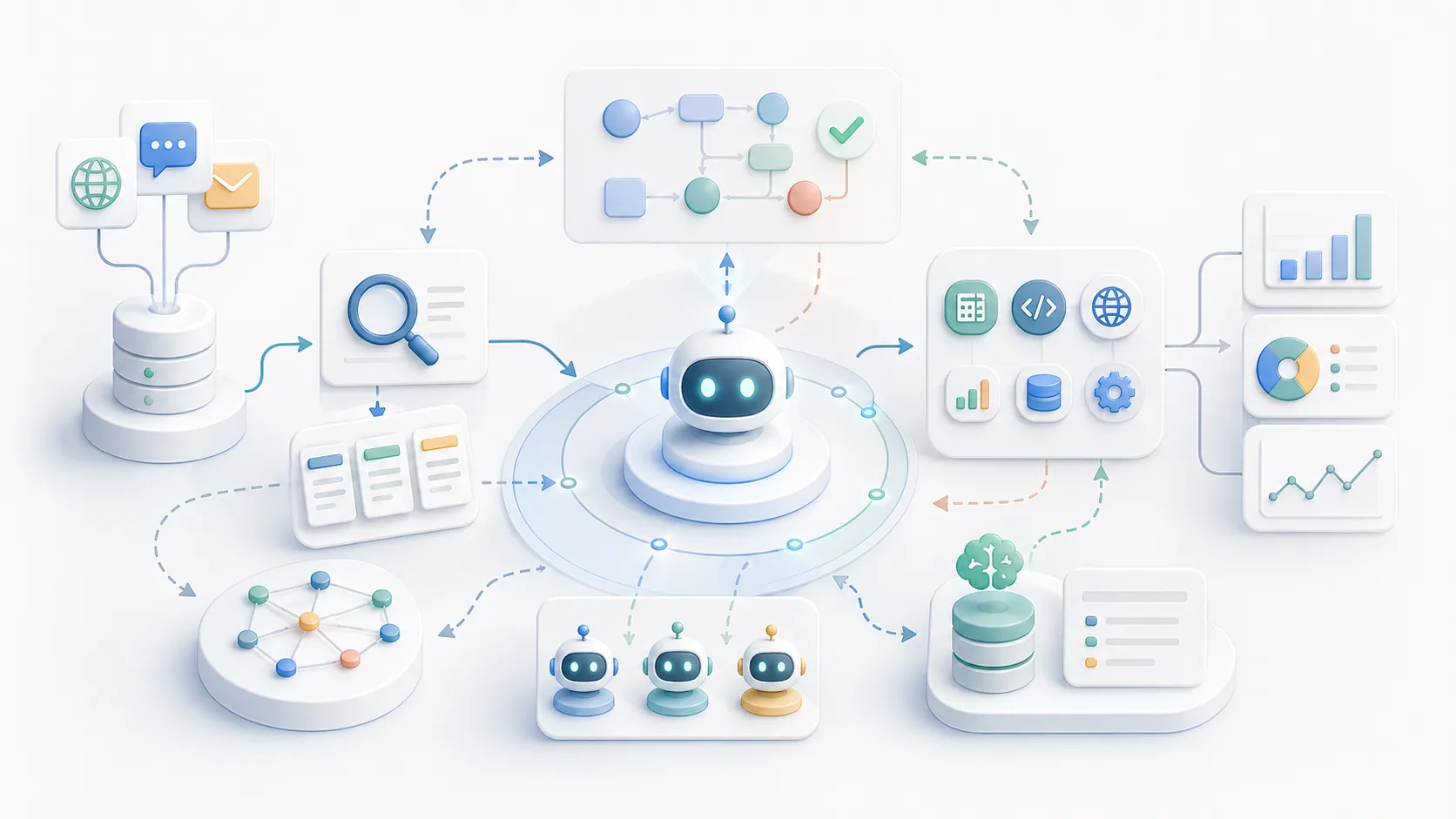
The core of Agentic RAG lies in introducing an AI Agent as the “brain” of the entire system. An Agent is an AI system capable of perceiving its environment, planning actions, using tools, and adjusting its strategy based on feedback. Within the Agentic RAG framework, after the Agent receives a user question, it doesn't go straight into a single retrieval, it first performs “task analysis”: judging the question's complexity, which data sources are needed, and what problem-solving strategy to adopt.
The Agent has a “self-reflection” capability: after each round of retrieval and generation, the Agent evaluates whether the information gathered so far is sufficient to answer the original question. If the information is insufficient, the Agent automatically adjusts its retrieval strategy, adds further queries, or even decides to use a different tool or data source. This dynamic, iterative mechanism lets Agentic RAG handle problems far more complex than traditional RAG can.
Agentic RAG's tool use capability is another key innovation. The Agent can call a variety of tools: vector database search, keyword full-text search, SQL database queries, external APIs (such as weather, stock, or regulatory databases), a code execution environment, and even other AI models (such as image recognition or OCR). By combining tools, Agentic RAG can handle complex, multimodal, multi-source query requirements.
Technical architecture in detail: the ReAct framework and Plan-and-Execute
Agentic RAG mainly relies on two core technical frameworks. The first is the ReAct (Reasoning + Acting) framework, proposed by Yao et al. in 2022. ReAct has the Agent alternate between “reasoning” (Thought) and “acting” (Action): the Agent first describes its current line of reasoning (Thought), then decides on the next action (Action), executes it and observes the result (Observation), and continues this thought-action loop until it reaches a final answer. This transparent reasoning process also gives Agentic RAG's decision-making explainability.
The second is the Plan-and-Execute framework. The Agent first performs a full breakdown of the complex question, generating a detailed problem-solving plan: which steps need to be carried out, what information each step depends on, and which tools to use. Once the plan is generated, another sub-agent (or the same Agent in an execution mode) carries out each step in sequence, updating the overall plan after each step is completed. This architecture is particularly well suited to long, multi-step complex tasks such as generating due diligence reports, competitive analysis, or regulatory gap comparisons.
In practice, Agentic RAG typically requires the following core components: a language model with sufficient reasoning capability to serve as the Agent's reasoning engine (such as GPT-5.6, Claude Opus 5 / Sonnet 5, or Gemini 3 Pro; for on-premise deployment, TAIDE, Gemma 4 31B, GPT-OSS, or the Mistral series can be considered. Note that Taiwanese government agencies and regulated industries are generally prohibited from using models from Chinese vendors, so confirm your organization's sourcing restrictions before making a selection); a function-calling interface that lets the Agent invoke external tools in a structured way; a vector database as the primary semantic retrieval backend; and a conversation memory management system to maintain context state across multiple rounds of interaction. Open-source frameworks such as LangChain, LlamaIndex, and AutoGen provide the foundational toolchain for building Agentic RAG.
Multi-hop reasoning and tool integration in practice
Multi-hop reasoning is the most striking capability improvement in Agentic RAG. Take finance as an example: when an analyst asks, “analyze the competitive dynamics between Company A and Company B in the Southeast Asian market,” Agentic RAG automatically breaks this down into: ① search for Company A's Southeast Asia business data, ② search for Company B's Southeast Asia business data, ③ compare their product lines and pricing, ④ analyze their respective market shares, ⑤ integrate market environment data, ⑥ generate a comprehensive analysis report. The output of each step feeds into the next step as context, ensuring the comprehensiveness and accuracy of the final analysis.
On the tool integration side, common tool combinations enterprises use when deploying Agentic RAG include: knowledge base semantic search (the core tool), SQL queries against enterprise databases (for structured data), CRM system APIs (for customer data), ERP system integration (for inventory and financial data), and external information sources (regulatory databases, news, industry reports). Through a unified tool routing layer, the Agent can automatically select the most appropriate combination of tools based on the type of question.
It's worth noting that Agentic RAG's multi-step execution introduces a latency challenge. Every additional tool call adds several seconds to the response time. When designing an enterprise Agentic RAG system, you need to balance “answer completeness” against “response speed.” Common strategies in practice include: setting a maximum iteration limit, caching tool-call paths for common questions, and using parallel tool calls so multiple tools execute at the same time to shorten overall wait time.
Enterprise adoption scenarios and benefits
Legal compliance is one of Agentic RAG's highest-value enterprise application scenarios. The questions legal departments face often require cross-referencing multiple documents: does a particular contract clause violate the latest amendment to the personal data protection act? Does a particular business practice comply with a specific country's competition regulations? Agentic RAG can automatically retrieve relevant statutes, precedents, and internal compliance guidelines, perform multi-dimensional comparisons, and compile a preliminary risk opinion with citations for legal staff to review. This kind of application can reduce the time spent manually paging through and cross-referencing documents, but the extent of the savings has no universal figure, it depends on document volume, format quality, and the complexity of the items to be checked, so it should be measured with a before-and-after test on your own case samples. More importantly, the key metric in a compliance scenario is the miss rate, not speed: it's best to first build an evaluation set of cases where legal staff have annotated which clauses should be hit, measure the system's recall against it, and position the AI's output as a draft rather than a conclusion, the final legal opinion still needs to be judged by a qualified professional.
Technical support and customer service is another important scenario. When a customer asks a complex technical question, such as “which component versions does my system integrate, which of them have known security vulnerabilities, and how do I patch them?,” Agentic RAG can first query the customer's system configuration data, then search security vulnerability databases for each component, and finally generate personalized patching recommendations tailored to that customer's environment. This capability goes far beyond what a traditional customer service knowledge base can offer.
Research and intelligence analysis is a third high-benefit scenario. Corporate strategy departments need to continuously monitor market dynamics, competitor moves, and technology trends. Agentic RAG can take on open-ended research tasks, automatically plan an information-gathering strategy, integrate internal and external data sources, generate a structured analysis report, and annotate the data source for each point made. This kind of semi-automated research assistant can potentially reduce the time spent gathering and organizing data, letting analysts focus their energy on interpretation and forming viewpoints. The actual benefit needs to be measured against your own process; recommended metrics to track include the data-gathering time per report, the accuracy rate of cited sources (spot-checking whether citations genuinely exist and support the point made), and the proportion of the draft that analysts rewrite, this last metric best reflects whether the system genuinely saves effort: if the rewrite proportion is too high, the time saved on gathering gets eaten up by the cost of rewriting.
Agentic RAG vs. traditional RAG: a key comparison
Understanding the differences between Agentic RAG and traditional RAG helps enterprises assess whether they need to upgrade their existing system. The comparison below covers several dimensions.
| Dimension | Traditional RAG | Agentic RAG |
|---|---|---|
| Retrieval strategy | Single fixed retrieval | Dynamic, multi-step, adaptive retrieval |
| Reasoning capability | Single-turn Q&A | Multi-step reasoning, self-reflection |
| Tool Integration | Vector search only | Multiple tools (API, database, computation, etc.) |
| Applicable question types | Simple, direct queries | Complex, multi-step, cross-source questions |
| Response time | Faster (a single retrieval plus a single generation) | Slower (increases with the number of iterations and tools used) |
| Implementation complexity | Moderate | Higher (requires Agent framework design) |
| Answer quality on complex questions | Limited by single-step retrieval; often loses points on cross-document questions | More likely to improve on cross-document, multi-condition questions (the extent needs to be measured yourself) |
| Cost | Lower (a single LLM call) | Higher (multiple LLM calls) |
This table is a qualitative comparison of architectural characteristics, not measured data. Latency and answer quality depend heavily on the model, data scale, number of tools, network conditions, and prompt design; please measure P50/P95 latency, answer accuracy, and per-query cost in the same environment using your own evaluation set before drawing conclusions.
As the table above shows, Agentic RAG doesn't completely replace traditional RAG, it's a capability upgrade for specific scenarios. Enterprises should decide which architecture to adopt based on actual business needs: for high-frequency, simple FAQ queries, traditional RAG remains the most cost-effective choice; for high-value tasks requiring deep analysis and complex reasoning, Agentic RAG may be worth evaluating in some situations. To judge whether it's worthwhile, you can use a simple projection framework: first estimate the incremental cost per query (the input and output tokens of multiple LLM calls multiplied by the current rate, plus tool-call fees), then estimate the change in the value of the manual hours it replaces or shortens and the change in error cost, only the comparison of these two is the real return on investment; if a task originally took a human only a few minutes to complete, the incremental cost is often difficult to recover. Many enterprises' actual deployments adopt a hybrid strategy: using traditional RAG for general queries and automatically switching to Agentic RAG mode for identified complex questions.
Further Reading
FAQ
References
- Yao, S., et al. (2022). ReAct: Synergizing reasoning and acting in language models. ICLR 2023. [arXiv]
- Wang, L., et al. (2023). Plan-and-solve prompting: Improving zero-shot chain-of-thought reasoning. ACL 2023. [arXiv]
- Shinn, N., et al. (2023). Reflexion: Language agents with verbal reinforcement learning. NeurIPS 2023. [arXiv]
- Schick, T., et al. (2023). Toolformer: Language models can teach themselves to use tools. NeurIPS 2023. [arXiv]
Want to know how Agentic RAG can be applied to your enterprise?
Contact LargitData's AI solution consultants. We'll assess the feasibility of adopting Agentic RAG based on your business scenario and provide customized technical architecture recommendations.
Contact Us