RAG vs. fine-tuning: a complete comparison guide to the key choice in enterprise AI deployment
When enterprises adopt generative AI, one of the most common questions is: 'Should we use RAG or Fine-tuning?' Both approaches offer distinct trade-offs across workflows and operational demands. RAG (Retrieval-Augmented Generation) augments LLM generation by dynamically retrieving context from external repositories; Fine-tuning modifies neural network parameter weights so models internalize domain knowledge and customized phrasing styles. This article compares both paths across cost, update agility, accuracy, and data security to empower technology leaders in making informed architectural choices.
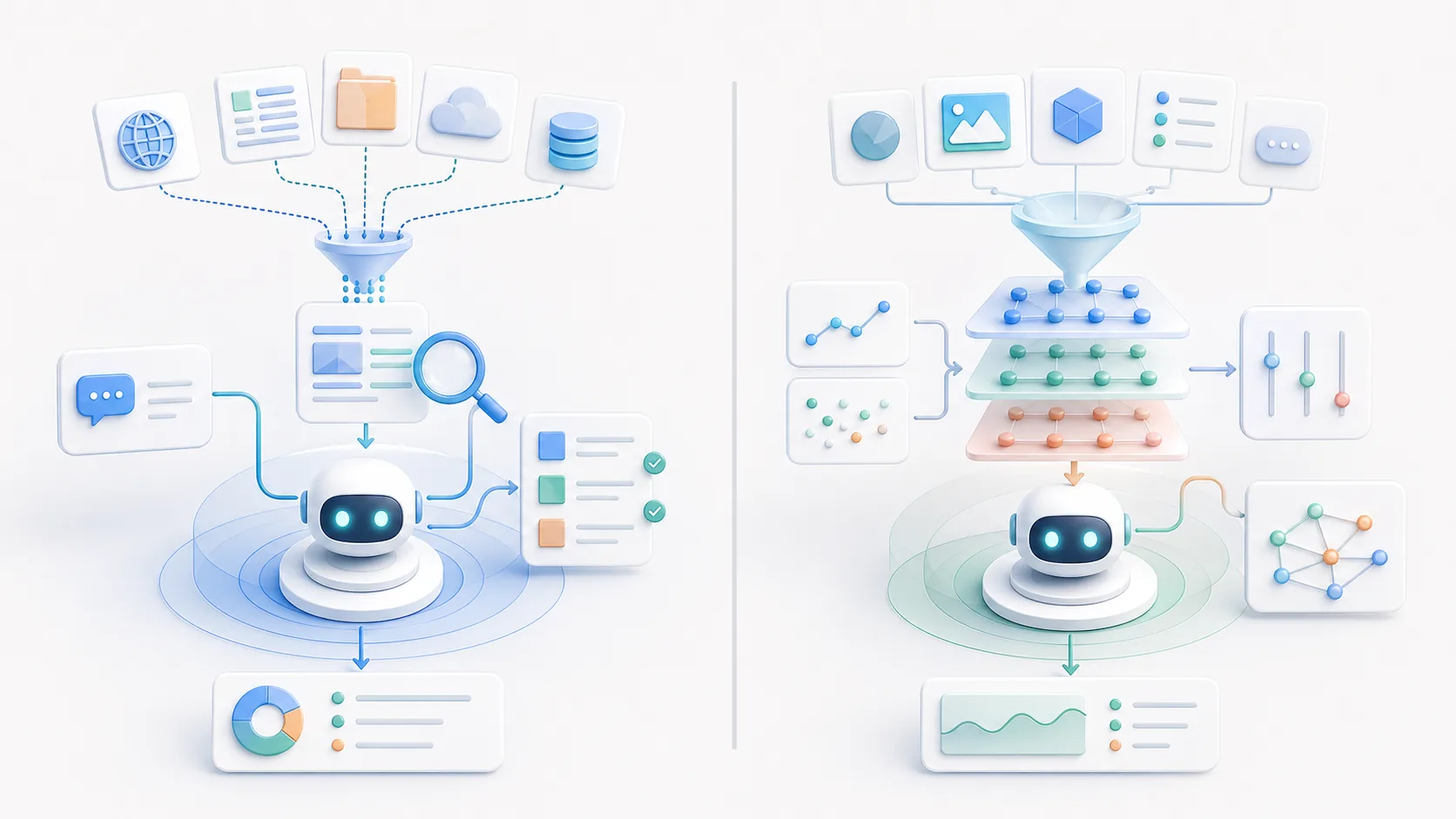
Core Differences Between the Two Technologies
RAG operates on 'query-time augmentation': the base language model remains unmodified; instead, for each incoming query, the system retrieves relevant document passages from external knowledge bases and feeds them alongside the query into the LLM. The model effectively references a cheat sheet during generation, enabling it to answer questions beyond its training cutoff date and incorporate proprietary corporate knowledge. In RAG, knowledge resides in the knowledge base (document store + vector index); updating knowledge requires only updating documents without touching model weights.
Fine-tuning operates on 'training-time learning': enterprises curate high-quality training pairs (Q&A pairs, dialogue exemplars, structured text) to further train foundational models, updating internal parameter weights. Fine-tuned models excel at specialized domain tasks, but their knowledge is baked into static weights: updating knowledge requires retraining runs, a labor- and compute-intensive endeavor.
This fundamental distinction dictates contrasting use cases. RAG's strength lies in dynamic knowledge: ideal for rapidly evolving corporate information; Fine-tuning's strength lies in behavioral consistency: ideal for enforcing strict response formatting, tone, and terminology alignment. Grasping this distinction is the cornerstone of effective architectural selection.
Cost and Time Investment Comparison
Regarding initial deployment outlays, RAG presents lower entry thresholds. Core investments include engineering hours for document parsing and indexing, vector database hosting/maintenance, and embedding API tokens (or on-premise embedding GPUs). A domain-specific RAG solution can typically reach an initial working version within weeks, making it ideal for rapid hypothesis validation.
Fine-tuning carries higher upfront investments, particularly in hidden expense categories. First is data preparation: fine-tuning efficacy depends heavily on dataset quality and coverage; cleaning, curating, labeling, and auditing require domain experts and cannot simply be outsourced. Timelines and budgets vary widely by domain complexity, existing data hygiene, and SME review requirements; pilot a small subset to establish empirical baselines before scaling estimates. Second is training and evaluation compute: fine-tuning requires dedicated GPU environments, with costs determined by parameter count, fine-tuning technique (full-parameter vs. LoRA), token volume, sequence length, and epochs. Equally underestimated is evaluation benchmarking: every iteration requires a standardized golden test dataset to measure improvements, representing a substantial asset investment in its own right.
Examining long-term maintenance costs, RAG inference incurs a marginal overhead over raw LLM calls due to vector retrieval lookups, yet its marginal cost for knowledge updates is near zero: simply modify documents without retraining compute. Fine-tuning inference costs align with model size, but every knowledge update requires retraining cycles; in rapidly shifting business environments, cumulative training compute accumulates into substantial recurring expenses.
Knowledge Update Agility Analysis
RAG delivers overwhelming superiority in knowledge agility. Enterprises simply add, update, or remove documents in the repository, and subsequent queries instantly leverage refreshed context without model retraining. However, note that 'no retraining' does not equal 'zero latency': actual turnaround depends on parsing, chunking, embedding generation, index ingestion, caching layers, and approval checkpoints, with batch scheduling utilized for massive datasets. Measure end-to-end ingestion latency and display indexing timestamps in UIs so users understand document recency. This capability is paramount for volatile knowledge domains like regulations, internal policies, and product catalogs. For example, updating compliance manuals in RAG after regulatory amendments ensures AI assistants immediately ground responses in current mandates.
Knowledge updates via Fine-tuning represent a time- and resource-intensive process. Each update cycle demands preparing new training data, executing fine-tuning jobs (spanning hours to days), benchmarking regression quality, and orchestrating model redeployments. In dynamic operating environments, this cadence struggles to keep pace with business requirements. Even more critical is Catastrophic Forgetting: injecting new knowledge risks degrading accuracy on historical domains, necessitating carefully engineered regularization and replay strategies.
Exception: When seeking to alter behavioral patterns rather than informational facts—such as tuning persona tone (formal vs. conversational), enforcing structured output syntax, or adopting industry-specific jargon—Fine-tuning is the optimal path because it shifts foundational generation dispositions rather than storing factual data.
Accuracy and Generalization Capabilities
Regarding accuracy, both approaches exhibit strengths across distinct query types. RAG delivers superior performance on factual Q&A, especially queries requiring citations of specific clauses, figures, and policy excerpts. Because answers ground in retrieved source passages, hallucination rates drop dramatically while providing source traceability (citing document titles and paragraphs). This traceability is paramount for high-stakes enterprise domains like legal, healthcare, and finance.
Fine-tuning excels on task-execution workflows, such as generating strictly formatted documents, code audits, or executing niche terminology conventions. Fine-tuned models internalize industry-specific syntax and reasoning heuristics, yielding natural and compliant domain outputs. However, fine-tuned models face the challenge of overfitting: if training sets lack sufficient variance, models perform flawlessly on verbatim training queries but degrade sharply when confronted with novel variations.
Crucially, for queries regarding facts post-dating model cutoff dates, RAG holds an inherent advantage: as long as the knowledge base is updated, RAG answers with up-to-date facts; fine-tuned models remain frozen at their last training checkpoint, blind to subsequent developments. In dynamic business environments, this is a vital operational consideration.
Data Security and Privacy Considerations
Data security is among the most sensitive topics in enterprise AI adoption. RAG and Fine-tuning exhibit starkly distinct risk profiles. RAG's security posture is highly manageable: knowledge repositories live inside enterprise vector databases deployable fully on-premise, keeping sensitive assets behind corporate firewalls. Knowledge stores support granular role-based access control: customer service reps access product manuals while remaining locked out of financial ledgers. Furthermore, RAG stores knowledge in enumerable, auditable documents and indexes; purging a document immediately removes it from retrieval queries, facilitating compliance with statutory right-to-erasure mandates (though backups, logs, caches, and legacy transcripts require independent remediation). Regulatory compliance with Taiwan PDPA or EU GDPR must be verified case-by-case against real data workflows by legal counsel.
Fine-tuning introduces intricate security challenges. Cloud API fine-tuning requires uploading training corpuses to third-party infrastructure, presenting significant exposures for datasets containing PII or proprietary trade secrets. Even in on-premise setups, fine-tuned models carry risks of training data memorization: research indicates LLMs can memorize specific training snippets and be prompted to leak sensitive fragments. From a compliance perspective, fine-tuning on datasets containing Personally Identifiable Information (PII) requires extreme caution.
Enterprise selection decision framework
Synthesizing the analysis above, we have structured a practical architectural decision framework to help technical leaders rapidly identify the optimal solution for their use cases.
| Scenario Characteristics | Recommended Solution | Explanation |
|---|---|---|
| Frequent Knowledge Updates (Weekly / Monthly) | RAG | Updates only require modifying documents without retraining |
| Requires Traceable Source Citations | RAG | RAG displays underlying source documents |
| Ultra-High Security Requirements (On-Premise Deployment) | RAG | Knowledge documents remain within enterprise boundaries without uploading training data |
| Rapid Proof of Concept (PoC) | RAG | Initial version deployable within weeks at low cost |
| Requires Modifying Response Tone or Output Format | Fine-tuning | Behavioral calibration requires modifying model parameter weights |
| Deep Internalization of Domain Terminology and Expressions | Fine-tuning | Such as precise usage of legal language or medical terminology |
| Relatively Static Knowledge (Annual Updates) | Fine-tuning | Acceptable update overhead, capitalizing on behavioral consistency advantages |
| Simultaneously requiring knowledge timeliness and behavioral consistency | RAG + Fine-tuning | Fine-tuning adjusts style, RAG provides up-to-date knowledge |
In practice, combining RAG with Fine-tuning is an evaluated hybrid pattern. A standard implementation applies lightweight fine-tuning (such as LoRA) on a small domain dataset to align terminology and output formats, then layers RAG on top so the fine-tuned model accesses real-time enterprise repositories. This hybrid captures behavioral consistency and knowledge timeliness simultaneously, yet requires maintaining dual pipelines: managing compatibility across model weights, adapter checkpoints, and vector stores. We advise confirming whether standalone RAG meets business needs before introducing fine-tuning complexity.
Further Reading
FAQ
References
- Lewis, P., et al. (2020). Retrieval-augmented generation for knowledge-intensive NLP tasks. NeurIPS 2020. [arXiv]
- Hu, E., et al. (2021). LoRA: Low-rank adaptation of large language models. ICLR 2022. [arXiv]
- Ovadia, O., et al. (2023). Fine-tuning or retrieval? Comparing knowledge injection in LLMs. [arXiv:2312.05934]
- Gao, Y., et al. (2023). Retrieval-augmented generation for large language models: A survey. [arXiv:2312.10997]
Still Unsure Whether RAG or Fine-Tuning Fits Your Enterprise?
Contact LargitData's AI consultants. We will evaluate your business workflows, data readiness, and budget to prescribe the optimal architectural roadmap.
Contact Us